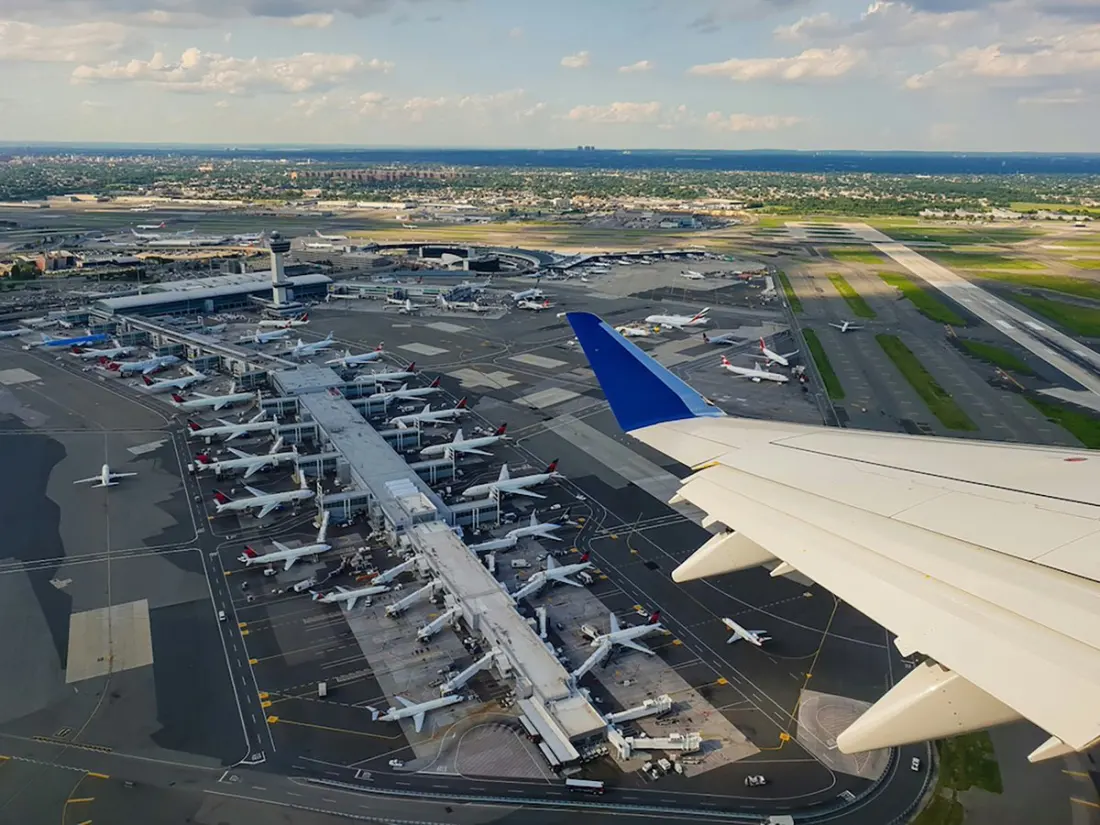
One severed fibre-optic cable brought the busiest air corridor in the United States to its knees — and now the US government says it needs $30 billion to make sure it never happens again.
The trouble started at Philadelphia TRACON, the facility that guides flights across the New York and Philadelphia region, when a primary telecommunications circuit failed. Controllers switched to a backup line — only to discover that construction work in New Jersey had cut through that fibre-optic cable too. Communications were down for roughly eight hours, and the fallout was enormous: about 9,500 flights delayed or cancelled and more than 100 diverted. Newark bore the brunt with over 600 cancellations, alongside major disruption at JFK, LaGuardia and Philadelphia.
Transportation Secretary Sean Duffy announced the day after the outage that the administration will ask Congress for an extra $30 billion, split three ways: $10 billion for ageing control towers and facilities, $10 billion for telecommunications and control technology, and $10 billion for airport infrastructure. It comes on top of the $12.5 billion Congress already approved in 2025 for the FAA's modernisation push, which would take total federal spending on the overhaul to about $42.5 billion.
The plan involves replacing decades-old copper lines, radios, radars and voice switches with modern digital systems. The FAA has also begun limited use of a new AI-driven platform called SMART (Strategic Management of Airspace Routes & Trajectories), which pulls around 200 data streams into one system to predict congestion, weather impacts and capacity crunches before they cascade into delays. FAA Administrator Bryan Bedford says the software, paired with the hardware upgrades, could meaningfully cut disruption.
There's a catch, though: nobody knows the final bill. A government review found the FAA has no comprehensive estimate of the programme's full lifecycle cost, and telecom spending has already crept up from $4.75 billion to $5.91 billion, with a second phase of systems work pegged at another $10.2 billion.
Why should travellers care? Because this is what fragility looks like from the window seat. One damaged cable at one facility rippled through four major hubs and kept wrecking schedules long after the line was repaired. And with the FAA forecasting more than 40% growth in commercial flights by 2046, the gap between creaking infrastructure and rising traffic will only widen. Until the upgrades land, anyone flying through the Northeast corridor — the most delay-prone airspace in the country — should build buffer time into connections, favour morning departures before knock-on delays stack up, and keep an eye on airline rebooking policies when booking tight itineraries. Even if you're not flying domestically, plenty of transatlantic routes touch this airspace, so the effects reach far beyond the US East Coast.
Travellers will be watching Congress closely: modernisation has shifted from a nice-to-have capacity project to a matter of basic reliability.