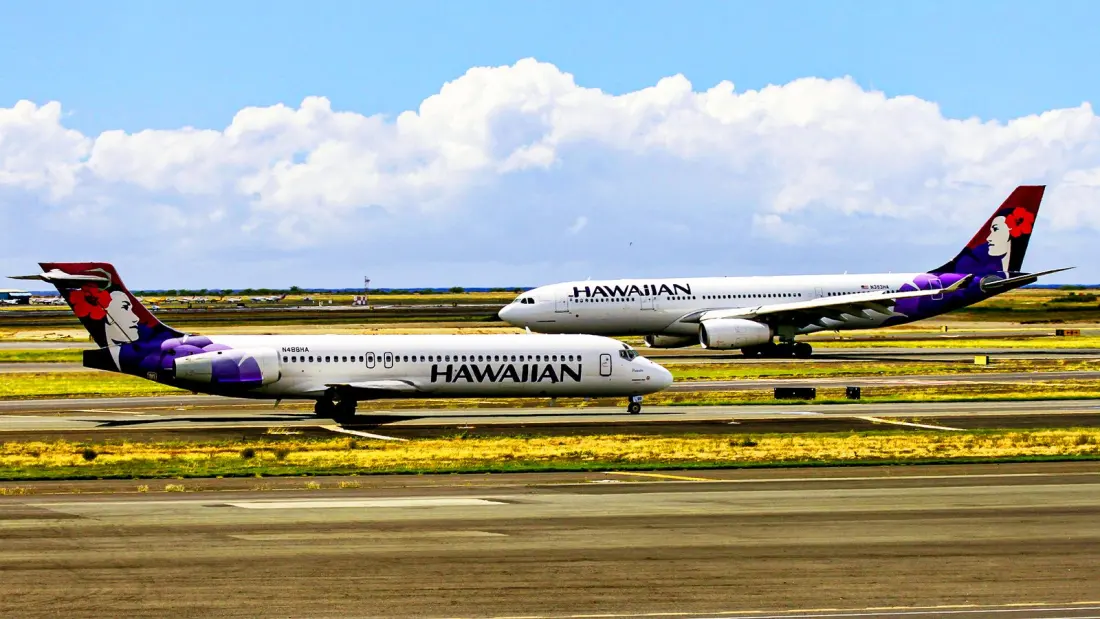
In Hawaii, the very first Boeing 717 to enter passenger service is still working flat out, nearly three decades after it rolled off the line. Aviation site Simple Flying tracked airframe MSN 55001, now registered N488HA and named Puaiohi, for 24 hours — and it flew ten separate sectors in a single day, racking up around 4 hours and 42 minutes airborne.
The day began at Honolulu's Daniel K. Inouye International Airport with a 07:07 departure to Lihue, a 21-minute hop, followed almost immediately by the return leg. The aircraft then shuttled between Lihue, Kahului on Maui, Kailua-Kona on the Big Island and, at 21:19, a final 35-minute flight to Hilo. Sectors averaged just 21 to 27 minutes in the air, with quick gate turnarounds in between — a schedule some Hawaiian 717s push to as many as 16 cycles a day.
This particular jet has a rare backstory. Built in 1998 as Boeing's flight-test aircraft for the MD-95 (later renamed the 717), it then flew in Australia for Impulse Airlines and Qantaslink before settling in Hawaii over two decades ago. Its longevity comes down to design: the 717 descends from the rugged DC-9 and MD-80 families, with a heavy aluminium fuselage and sturdy landing gear built for exactly this kind of short, high-frequency flying, plus Rolls-Royce BR715 engines tuned for rapid climbs on brief hops.
Travellers may notice something different about these flights too: since Alaska Air Group's merger with Hawaiian Airlines, the interisland rotations now carry Alaska's AS flight numbers, though the onboard experience remains distinctly Hawaiian. Mainland passengers can connect onto the island-hoppers on a single booking.
The clock is ticking, though. Hawaiian plans to retire its 717s and move interisland flying to Boeing 737-800s starting in 2028, while Delta, the type's biggest operator, is swapping its fleet for Airbus A220s. When they go, the DC-9 bloodline — one of aviation's most durable lineages — will effectively end. If you want to fly the world's oldest active 717, the window is closing fast.