
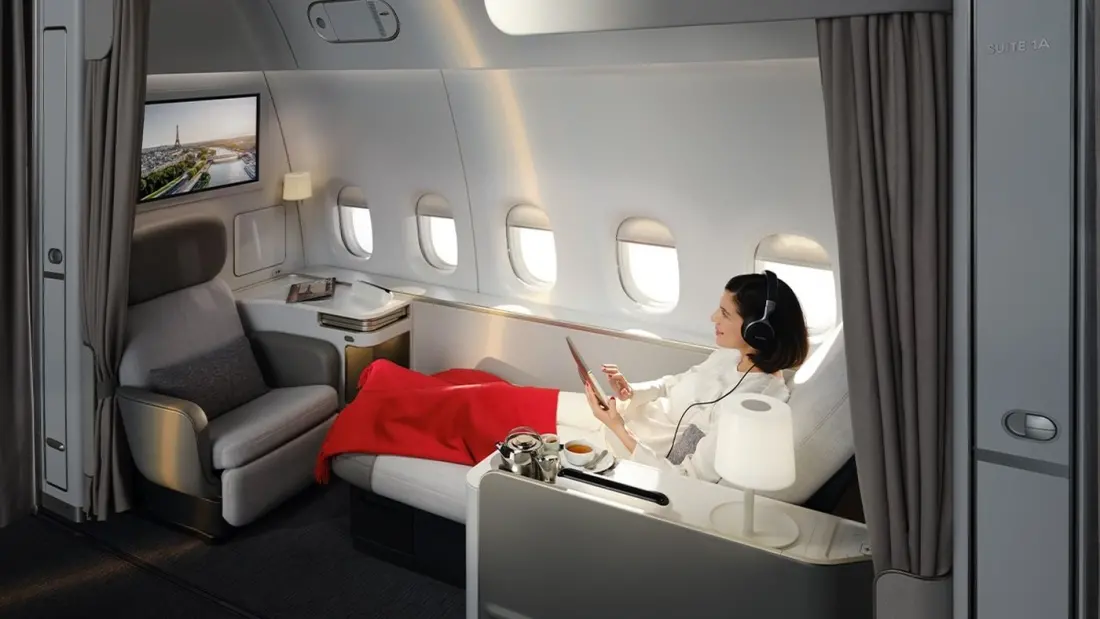
While airlines worldwide are cutting capacity and worrying about fuel costs, Air France-KLM just posted an 11% jump in premium cabin revenue — even after raising fares. CEO Ben Smith credits the carrier's heavy investment in luxury travel, notably its La Première first class, with insulating the airline from turbulence like higher fuel prices and disrupted travel patterns linked to the conflict involving Iran.
The logic is simple: someone booking La Première isn't going to cancel a trip over a few hundred (or thousand) dollars in fare increases. In fact, Air France says it has been winning over former private jet passengers — people looking to sidestep both the cost of private aviation and its growing environmental stigma. For them, a private suite with a dedicated chauffer transfer to the aircraft is an easy swap.
What makes La Première work isn't just the seat. Reviewers who have flown it describe an end-to-end service: escort through security, a dedicated lounge in Paris, then a private car ride across the apron straight to the aircraft for connections — turning Charles de Gaulle, one of Europe's most stressful airports, into a frictionless experience. Onboard, it's the private cabin, caviar, champagne and restaurant-quality French dining. Travellers reportedly pay over $100,000 for four round-trip La Première tickets from the US and consider it better value than a private jet.
There's also deliberate scarcity at play. La Première exists only on select Boeing 777-300ERs, with just four seats per aircraft. Mileage redemptions are tightly restricted, and the airline refuses to fill empty seats with discounted upgrades or staff travellers. That exclusivity is the point — it protects pricing and reinforces the brand.
The strategy ripples down through the cabin. Air France's new A350 business class suite on the Paris–New York route — with spacious suites, French catering and free Starlink Wi-Fi — has been called the best business class in Europe, arguably rivalling Qatar Airways globally. First class acts as a halo: few passengers buy it, but everyone aspires to it, and it makes the cabins behind feel more premium. Paris itself helps, as a global capital of fashion, food and hospitality that the airline deliberately leans into — even mandating that onboard products be French.
The lesson isn't that every airline should revive first class. American Airlines was probably right to kill its international first product, which never offered genuine exclusivity or standout service. Air France succeeds because it keeps widening the gap between business and first, in a market with deep premium demand and a home city that sells luxury by default.
For travellers, the takeaway is practical: if you're splurging on a long-haul trip to Europe, Air France's premium cabins are currently among the strongest products in the sky — and the ground experience alone justifies a look.