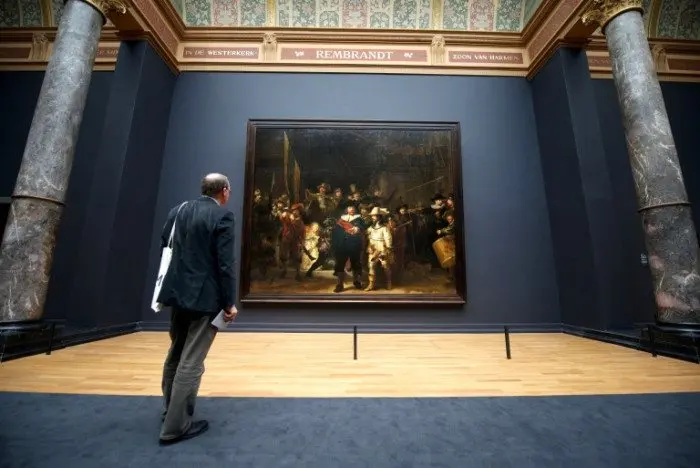
Rembrandt's Night Watch has been stared at by millions. Almost nobody realised they were also looking at a colony of microscopic organisms. A new exhibition in Amsterdam, The Night Watch Lives, makes that hidden layer visible by growing bacteria sampled from the surface of the 17th-century masterpiece and displaying them in Petri dishes next to a life-sized reproduction of the painting.
The show is a collaboration between two very different neighbours: the Rijksmuseum, where the painting hangs, and Artis-Micropia, the city's quirky "microbe zoo". Researchers spent six months swabbing around sixty spots on the canvas, then cultivated what they found into colonies for visitors to inspect up close.
So what lives on one of the Dutch Golden Age's most famous works? Mostly familiar characters. Microbiologist Eline van Bloois of Artis-Micropia told AFP that many of the microbes are types commonly found on human skin or in soil — unsurprising for a painting that has been in public view for centuries. The good news for conservators: none of them harm the painting.
The genuinely puzzling find is Microbacterium saccharophilum, a bacterium typically associated with a Japanese sugar refinery, discovered in an area where the varnish had been removed. How it got there is anyone's guess — van Bloois admits it will keep her up for years. She also poured cold water on a romantic idea: while it would be thrilling if some microbes traced back to Rembrandt himself, a single bacterium can't be dated, so there's no way to tell whether it has ridden on the canvas for 400 years or arrived yesterday.
The exhibition is part of Operation Night Watch, an ambitious research and restoration project running since 2019, in which the painting is examined inside a purpose-built glass chamber at the Rijksmuseum. The larger aim of the microbe show is to spark curiosity about the invisible life teeming around us — and, as van Bloois puts it, to show that art and science aren't opposites. She even suggests the dishes of colonies are small artworks in their own right.
For travellers, this is a nice excuse to see two Amsterdam museums in one trip. The Rijksmuseum remains the draw for the painting itself, where you can watch the ongoing restoration work through the glass. Artis-Micropia, next to the Artis Royal Zoo in the Plantage district, is one of the world's only museums devoted entirely to microbes, and The Night Watch Lives opens there on November 11. It's a short, family-friendly detour that turns a masterpiece you've seen in a thousand reproductions into something genuinely strange.