Expedition cruise operator Aurora Expeditions has expanded a partnership with ocean-tech firm CounterCurrent, putting its AI navigation system on all three of the company's ships after a successful Antarctic trial.
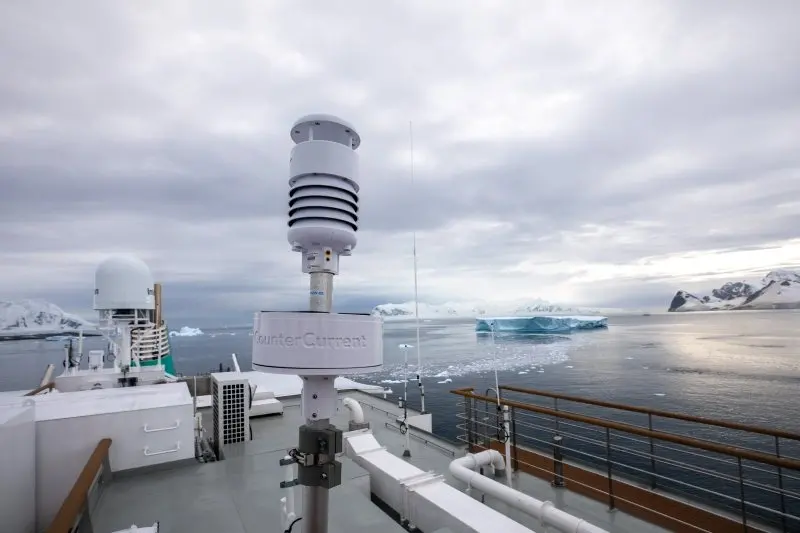
The technology first went to sea aboard the Douglas Mawson during the 2025-26 Antarctic season. Following that trial, it has now been installed on the Sylvia Earle and Greg Mortimer, both fitted with the upgraded CounterCurrent Mark 3 Triton sensors. These are designed to keep collecting reliable data in remote waters — including when there's no sunlight or satellite connection, a real consideration at high latitudes.
The idea behind the system is simple enough: it combines AI forecasting, ship-mounted sensors and real-time ocean observations to find routes that work with currents rather than against them, cutting fuel burn without necessarily adding sailing time. CounterCurrent founder Professor Shane Keating describes it as "Google Maps for the Sea".
The Antarctic trial produced some solid numbers. Over 126 days of operation, the system generated 39 route recommendations and logged more than 5,600 environmental observations. Early sea trials point to fuel savings of 2-5 percent over 24 hours, with preliminary modelling suggesting up to 5-15 percent in favourable conditions, depending on the vessel, speed and route. Aurora is careful to stress those figures are early days and need longer-term validation.
There's a sustainability angle here, obviously — less fuel means lower emissions — but also a passenger-facing one. Aurora's head of sustainability and passenger experience, Sasha Buch, framed the partnership as a way to operate more efficiently in fragile environments while feeding real-world data back to the wider maritime industry.
What comes next is arguably the more interesting part. Aurora plans to test fleet-wide forecasting, so observations gathered by one ship improve route advice for the others working the same region. Development is also under way on onboard forecasting that would reduce dependence on cloud-based processing — handy when you're sailing somewhere satellites are patchy at best.
Why should travellers care? If you're booked on an Antarctic or Arctic voyage with Aurora, your ship is now quietly riding ocean currents with the help of machine learning — likely burning a bit less fuel and contributing data that could make polar cruising cleaner industry-wide. It's a small but tangible step toward more responsible expedition travel, and a glimpse of how AI is moving from booking engines into the wheelhouse.