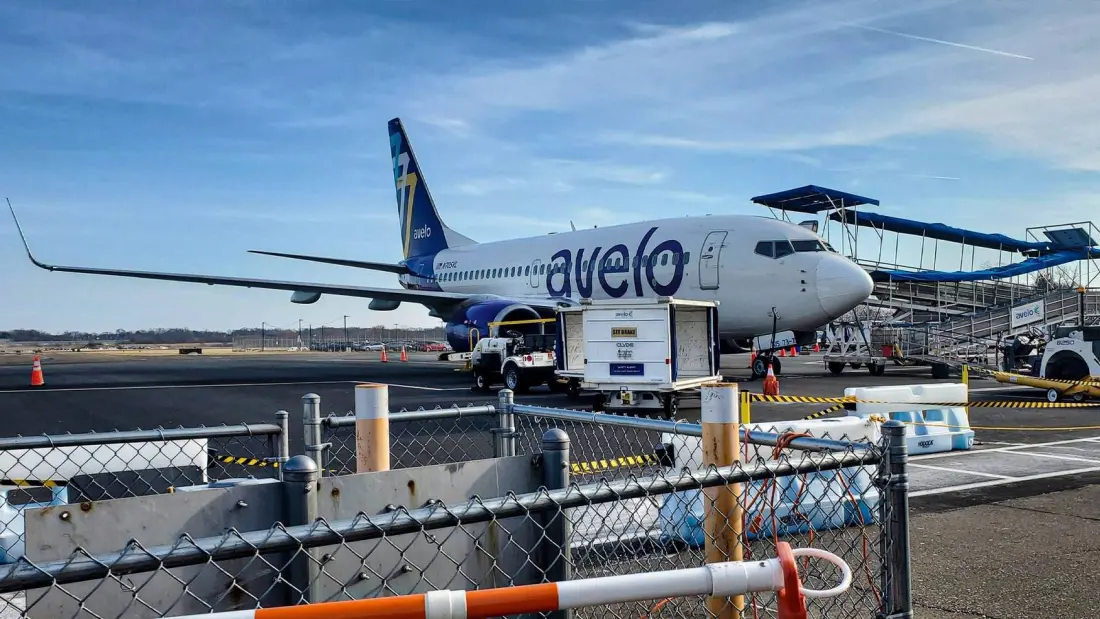
Avelo Airlines has quietly launched two new routes from Tampa International this November, but a glance at the destination codes tells you something odd is going on. Instead of flying to Dallas/Fort Worth (DFW) or Charlotte Douglas (CLT), the budget carrier lands at McKinney National Airport (DTX) north of Dallas and Concord Regional Airport (USA) outside Charlotte.
The details: Tampa–McKinney runs four times a week and Tampa–Concord twice weekly, both on Boeing 737-800s. McKinney sits roughly 30 miles from downtown Dallas, while Concord is about 17.5 driving miles from central Charlotte — close enough to serve the metro areas, but far enough from the mega-hubs to change the economics entirely.
This isn't an accident. Avelo, which only started flying in 2021, has built its whole network around secondary airports where it faces little or no competition. It's the sole passenger airline at McKinney, and shares Concord only with Allegiant Air. Its largest base is New Haven, Connecticut — a place so far from any major hub that nonstop leisure flights have real appeal. Lakeland, Florida and Wilmington, North Carolina round out its base map.
The logic is straight out of the Ryanair playbook. A route from Tampa to DFW would put Avelo head-to-head with American Airlines, which has better schedules, connecting traffic, premium cabins and a loyalty program. Competing there means fighting on price alone against an opponent that can afford a fare war. At McKinney or Concord, Avelo pays far less in airport costs, faces no entrenched rival, and becomes the most convenient option for suburban travellers — particularly in fast-growing North Dallas — who'd rather skip DFW altogether. Cheap, nonstop flights to a sunshine destination can even create demand that never existed before, the same approach Brazilian carrier Azul has made famous.
For travellers, the trade-offs are real. You're getting an ultra-low fare and a nonstop to a vacation market, but no lounge, no first class, no frequent-flyer ecosystem worth mentioning, and a schedule of just a couple of flights a week. Miss it and you're rebooking, not hopping on the next departure. If you live on the right side of Dallas or Charlotte, though, that calculus flips fast — a 15-minute drive to a small terminal often beats an hour crawling toward a mega-hub for a leisure trip.
It's a crowded and shifting market for the ULCCs. Allegiant is absorbing Sun Country (full merger due 2028) and adding a first class cabin in 2027; Frontier is doing the same while pruning unprofitable routes. Avelo, meanwhile, has 15 aircraft serving over 30 destinations, has trimmed older 737-700s and shut money-losing operations including its Burbank base, and is betting big on a future fleet of up to 100 Embraer E195-E2s with deliveries from 2028. It lost money in 2025 and high fuel prices have squeezed it since, so the small-pond strategy isn't just preference — it's survival.
If a Tampa trip is on your list and you're near McKinney or Concord, the new routes are worth a look. Just book early: with two to four weekly frequencies, flexibility is limited and a single cancelled flight can derail your plans.