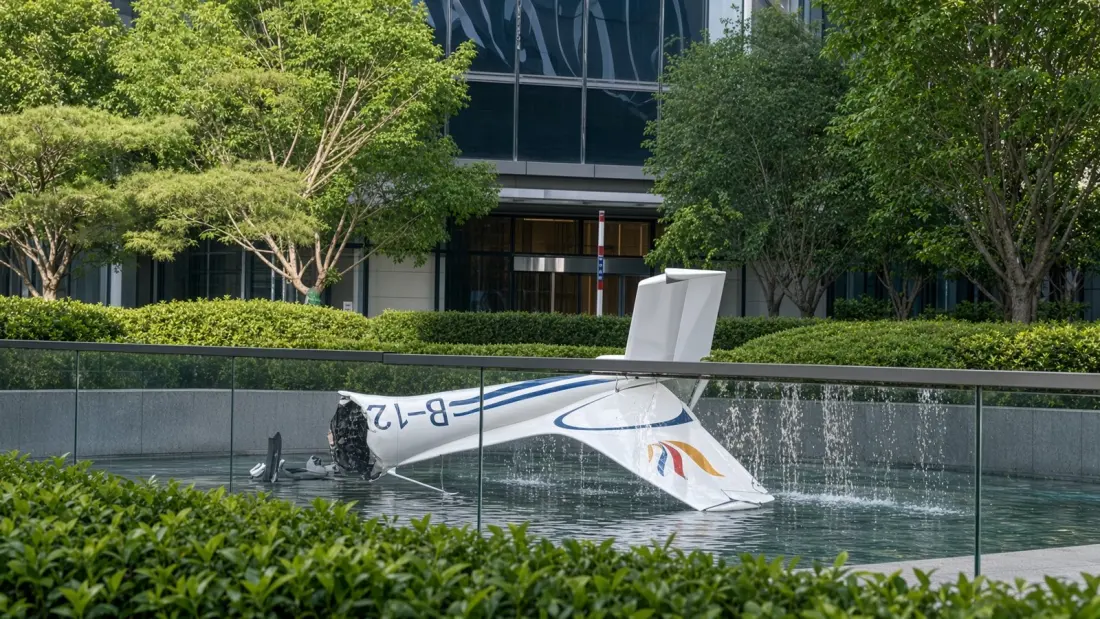
A single-engine light sport plane slammed into CITIC Tower — the 528-metre China Zun, Beijing's tallest skyscraper — on the evening of June 26, killing the 66-year-old pilot and injuring 13 people on the ground. Now Chinese authorities have responded with one of the most sweeping airspace lockdowns anywhere in the world: a permanent restricted zone roughly 600 kilometres wide, covering more than 280,000 square kilometres — an area approaching the size of Italy.
The aircraft, a two-seat Sunward SA60L Aurora with registration B-12PP, had taken off from an airfield in Pinggu on Beijing's eastern outskirts before heading into the city. It struck the tower in Chaoyang district around 5:55 p.m., during the evening rush. Wreckage and shattered facade panels rained onto the streets below, damaging a taxi and forcing road closures around the building. Police reportedly stopped bystanders from photographing the scene, and mentions of the crash were quickly scrubbed from Chinese social media.
The pilot's background has drawn as much attention as the crash itself. Authorities describe a divorced Beijing man who lived alone, struggled with chronic insomnia and anxiety, and had written repeatedly about suicide in his diary. He earned a sport pilot's licence in 2021 and a private licence in 2024. The incident has prompted uncomfortable questions online about how a small aircraft could reach the heart of a capital with such heavy air-defence coverage.
The new restrictions cover Beijing, Tianjin and much of Hebei province, plus parts of several neighbouring provinces and the Bohai Sea. Scheduled airlines are exempt, so commercial flights in and out of Beijing's airports continue as normal — holidaymakers flying in need not expect disruption. General aviation, approved business flights and government operations can still fly, but only on filed flight plans, with radio contact and continuous electronic tracking.
For travellers, the most practical change concerns drones. Separate rules taking effect November 15 broadly prohibit possessing or storing drones — and even their core components — within Beijing municipality, with narrow exceptions. Residents are being encouraged to surrender equipment or ship it out of the city. That means a camera drone packed in your suitcase could be a problem the moment you arrive, even if it never leaves the box. Aviation regulators are also proposing deeper background checks for pilot licence applicants, including students, sport pilots and drone operators, extending to family members' histories.
China already kept a tight grip on flying around its capital before this, with large swathes of airspace reserved for the military. The crash has pushed that control to a new extreme and prompted temporary groundings of private pilots elsewhere in the country. For visitors, the takeaway is simple: leave the drone at home, expect continued smooth airline service, and be aware that photography around sensitive incidents may attract police attention.
First reported by View from the Wing.