
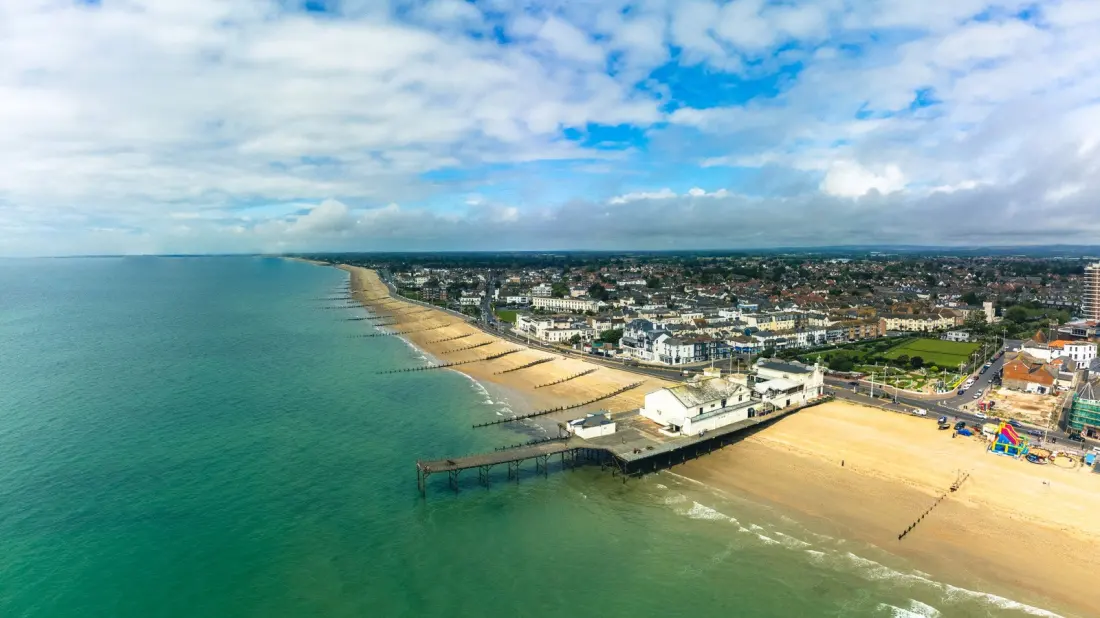
A direct train from London Victoria in under two hours drops you in one of Britain's sunniest spots, and it's not Brighton or Bournemouth. Bognor Regis, sitting halfway between Portsmouth and Worthing on the West Sussex coast, was ranked the third sunniest location in the UK by Sunsave in 2026 — and it has the history to match the weather.
The town's story stretches back to Saxon times, when it was known as Bucgan Ora, meaning Bucge's Shore. It grew from a fishing village (with a side line in smuggling) into a fashionable resort in the late 1700s thanks to developer Sir Richard Hotham. Its regal suffix came in 1929 after King George V convalesced there from a lung illness — a royal seal of approval for the sea air that still fits today.
The beaches are shingle rather than sand, though flat sandy banks appear at low tide. East Beach, right by the Victorian pier, is the popular pick: lifeguards patrol from May to September, and the promenade's cafés and concession stands are steps away. For something quieter, Aldwick (West Beach) has its own parking and a seasonal café — plus a couple of surprises. Fossil hunters sift the London clay at low tide, and history fans can find an abandoned pontoon left over from the D-Day preparations of 1944.
Bognor has its critics — some call parts of it run-down — but there's a genuine revival effort underway, including restoration of the 102-year-old clock and stained glass in the historic arcade. Shopping-wise, London Road mixes chains with charity and thrift stores, while Grandad's Front Room, a community-run antique shop, is exactly the kind of time-warp place the town does best. An old-school sweet shop selling handmade boiled sweets seals the nostalgia deal.
What really sets Bognor apart for walkers is its six heritage trails. Families can try the one-mile Hotham Park Tree Trail, which points out coastal redwoods among other species, or the flat, wheelchair-accessible Seafront "Fun and Facts" Trail with its low-level history placards. The three-mile Blue Plaque Trail is the headline act: it leads to the house where James Joyce wrote part of Finnegans Wake in 1923, and into neighbouring Felpham, where William Blake composed the poem that became the hymn "Jerusalem."
For travellers, Bognor Regis makes sense as an easy, car-free seaside break from London, or as a stop on a south coast road trip — it's about 40 minutes from Portsmouth or Worthing by car, and under an hour from the cliffs and woodland of South Downs National Park. It won't dazzle you with boutique dining, and that's partly the point: this is an honest, walkable English resort with royal history, literary footnotes, and more sunshine than most of the country.