On the evening of 1 November 1918, a Brooklyn Rapid Transit train derailed in a tunnel just short of Prospect Park station, killing close to 100 people and injuring around 250 more. It remains the worst catastrophe in New York City subway history, and the worst train crash in New York State — yet the street where it started was renamed Empire Boulevard within a month, and the victims went unmarked for a full century.
The disaster was a pile-up of failures. A union strike that morning left the private BRT scrambling to staff its trains, so a crew dispatcher named Antonio Edward Luciano was put in the motorman's seat with under three hours of classroom training, a 10-hour shift already behind him, and grief of his own — he had buried his second daughter days earlier, one of countless flu deaths in the deadliest month of the 1918 influenza pandemic.
The train itself was a problem too. The wooden cars were about 30 years old, lacked headlights and a speedometer, and had been coupled with the two lighter, top-heavy trailer cars side by side instead of separated by heavier motorised ones. After an eight-minute wrong turn near Fulton and Franklin — a blown indicator fuse meant the tower operator didn't recognise the Brighton Beach-bound train — Luciano appears to have been making up lost time. When he hit the sharp S-curve before Prospect Park, with a six mph limit, he was travelling at roughly 30 mph by his own estimate. The first car jumped its rails, slamming the second and third into a concrete wall and shearing off roofs and left-hand sides.
Rescue was slow to start; the wreck was hidden in an unlit tunnel, and it took 45 minutes for an organised response to begin. No one faced criminal charges, though civil claims bankrupted the BRT. Safety upgrades like timed signals and automatic braking followed, but wooden cars ran on the system for decades more.
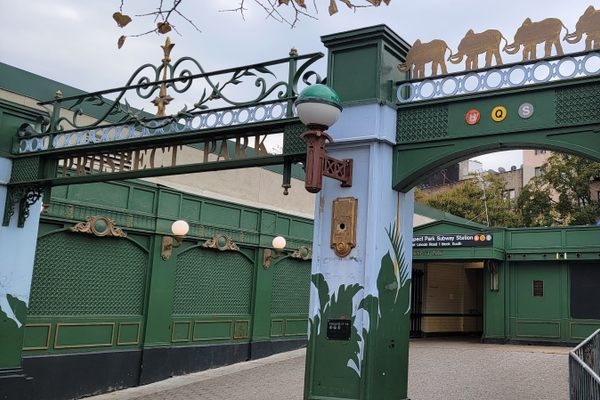
Only in 2019, on the centennial, did a bronze plaque go up at the northern entrance to Prospect Park station, and the Empire Boulevard/Flatbush Avenue intersection was co-named Malbone Centennial Way. For curious travellers, the site is easy to find: riding the Franklin Avenue Shuttle southbound, the tunnel entrance comes into view on the right just before Prospect Park station. You can also look down the shuttle right-of-way from a bridge opposite 1035 Washington Avenue, or spot the tunnel's southern end from the southbound platform — the platform that 6:14 p.m. train never reached.
It's a sobering, quietly moving detour for anyone interested in New York's hidden history, and it pairs naturally with a visit to the Brooklyn Botanic Garden next door (the crashed train had blown past what's now the Botanic Garden station) or Prospect Park itself. Prospect Park station is served by the B (weekdays) and Q trains plus the Franklin Avenue Shuttle.