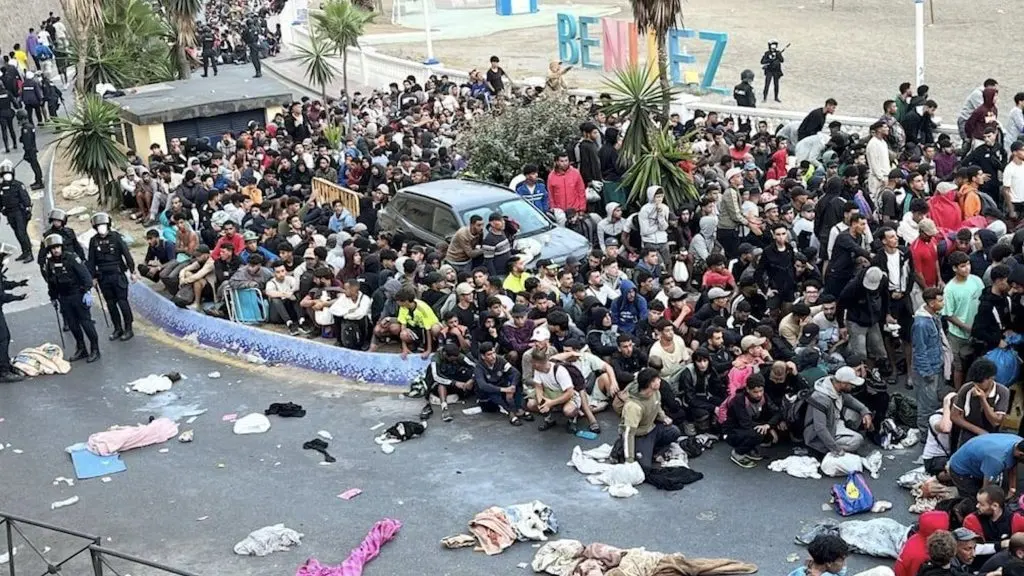
Ceuta's big push to clear the migrant camps from its beaches ran out of room almost as soon as it started. On Friday 18 September, Spanish police moved hundreds of people from Benítez beach into temporary reception tents at the city's port — but the facility's capacity of roughly 1,700 places was nowhere near enough for the more than 4,000 people estimated to be living in the makeshift settlements around Benítez and El Trampolín.
The operation, cleared by a National Court ruling the previous day, began shortly before 7am with around 150 National Police officers backed by the Guardia Civil and military. It was chaotic from the start: hundreds of people who had waited through the night with their belongings packed began running towards the port before the main police deployment was in place, and reinforcements had to halt the crowd near the end of Benítez beach. During the first hour a crush developed at the police-controlled passage; officers fired shots into the air and several people were reported injured. By around 11am the largest reception area was already full, and by mid-morning the remaining smaller tents had filled too. Those left waiting — including the entire El Trampolín camp, which was cordoned off and told it would not be moved that day — drifted back to the beaches.
Police pulled several children out of the queues, since the port facility is designated for adult men only, and no dedicated reception centres for minors are currently available in the city.
The fallout has been sharp. Ceuta's Port Authority president, Juan Manuel Doncel, who had formally opposed using the port for accommodation, said ministries had kept him in the dark and complained the area had effectively been "occupied for 50 days", warning that the camps sit beside infrastructure critical to the city and could disrupt logistics. The National Police union Jupol said authorities failed to guarantee sufficient capacity, resources or conditions, while opposition leader Alberto Núñez Feijóo accused the government of being unable to maintain public order in a Spanish city — criticism the government called irresponsible, insisting the unprecedented transfer had gone as well as could be expected.
For travellers, Ceuta is a small Spanish enclave on the north African coast, usually reached by ferry from Algeciras, and the port is the city's main gateway. With the Port Authority publicly warning about pressure on logistics and port security, anyone planning a crossing or a trip to Ceuta should expect possible disruption around the port area and check ferry status before travelling. The wider political standoff shows no sign of resolving quickly, and the underlying problem — far more people than places — remains unsolved.