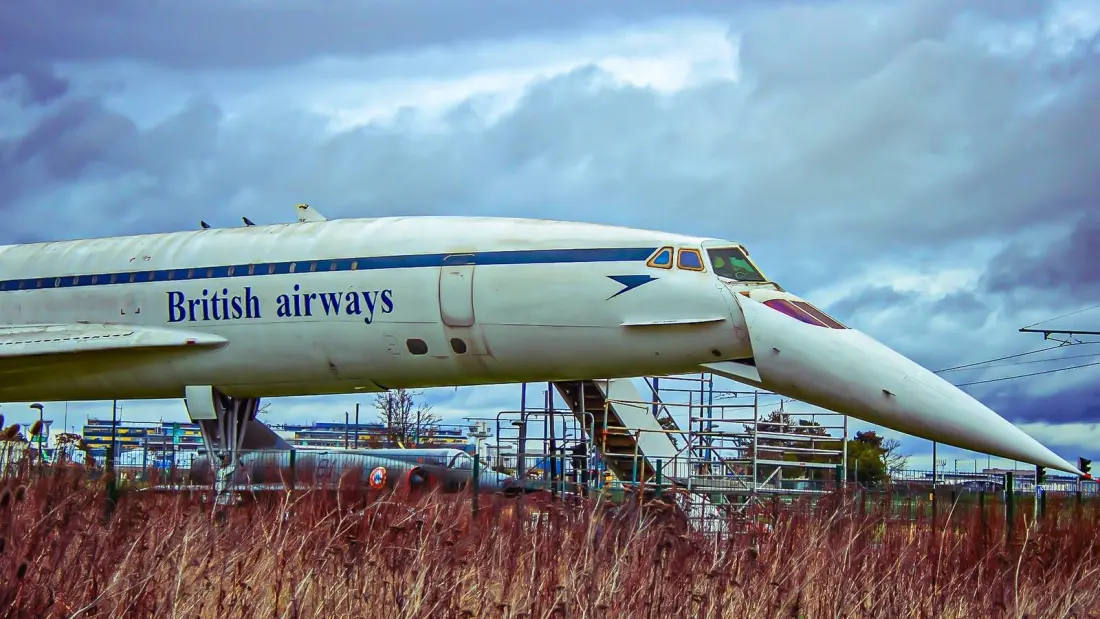
Few aviation images are as memorable as Concorde lowering its slender nose before landing. That elegant piece of Anglo-French engineering let the delta-winged jet see the runway at slow speeds, then snap back into a needle-sharp cone for Mach 2.02 cruising. Yet the startup companies hoping to bring back supersonic passenger travel — including Boom Supersonic with its XB-1 demonstrator and upcoming Overture airliner — have no plans to copy it. The moving nose, it turns out, is a solution whose time has passed.
The problem it solved was real. Concorde's delta wing generated lift differently from a conventional airliner's wings, using vortex lift instead of flaps and slats. That meant the aircraft had to approach the runway with its nose pitched steeply upward, which would have left pilots staring at sky instead of tarmac. Engineers at Marshall of Cambridge came up with an articulating nose hinged to the forward pressure bulkhead, running through four configurations: nose up with visor raised for cruise, visor down for pushback, nose five degrees down for taxi and takeoff, and a full 12.5-degree droop for landing.
It worked, but at a price. The system needed heavy hydraulic actuators pressurised to 3,000 psi, a backup circuit on permanent standby, locking hooks, and a heat-resistant visor — nose temperatures exceeded 127°C in cruise. Every flight cycle battered the seals and hoses with thermal shock and vibration, causing leaks and long inspections. A mechanical break in a Mach 2 fuselage also meant serious reinforcement and, for crews, pitching quirks to manage during approach.
Modern certification rules make that kind of articulating, load-bearing structure close to a non-starter. Bird-strike and pressurisation testing on a hinged nose would be brutally expensive, and every kilogram of plumbing eats into payload and range. Designers estimate ditching the moving parts saves roughly 900 kilograms. Boom's answer is a flight vision system: nose-mounted cameras stream live footage into augmented-reality displays, letting pilots effectively see through a solid composite nose during high-pitch approaches.
NASA is pushing the idea further with its X-59 research aircraft, which has no forward windshield at all — just a 4K external camera feeding an ultra-high-definition screen, backed by terrain databases. If regulators accept that cameras satisfy see-and-avoid requirements, the legal path is open for windowless supersonic cockpits everywhere.
For travellers dreaming of New York in under four hours, this is good news. The economics that killed Concorde — tiny cabins, punishing maintenance, poor daily utilisation — are exactly what the new designs aim to fix. Fewer moving parts mean faster turnarounds, more seats, and, eventually, tickets that don't require a lottery win. The droop nose stays a museum piece; cameras and screens will do the looking instead. Credit: Simple Flying.