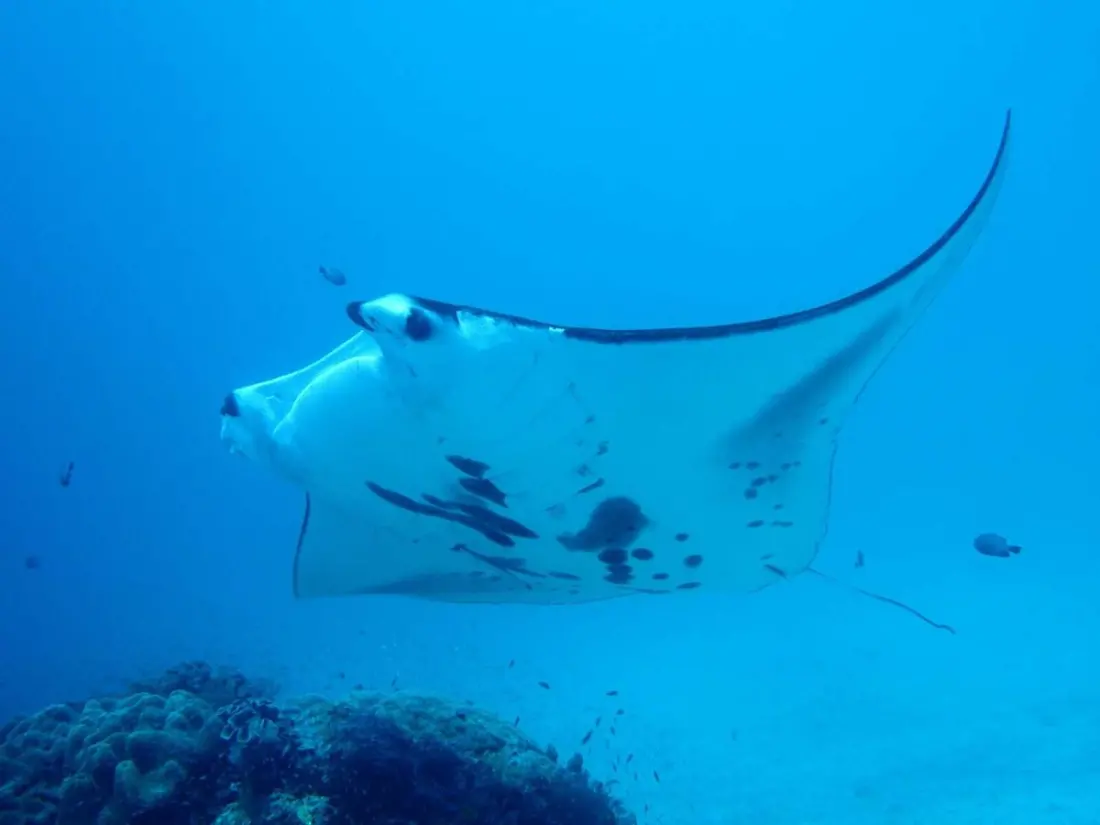
New tracking research out of Costa Rica shows that giant manta rays live very different lives depending on their age — and that has big implications for both conservation and the divers who come to see them.
The study, published in Frontiers in Fish Science by researchers at Mantas Costa Rica and partner organisations, followed mantas along the Pacific coast between 2018 and 2025. The team fitted acoustic transmitters on 59 rays, used satellite tags on 12 more, and logged more than 12,000 detections across sites including the Murciélago Islands and Catalina Islands in Guanacaste, Cabo Blanco, Caño Island and remote Cocos Island, over 500 kilometres offshore.
The pattern was clear. Juvenile mantas stay in shallow coastal waters, where they get reliable food, cleaning stations where smaller fish remove parasites, and shelter from predators like large sharks and orcas. Those same reefs appear to double as social hubs — the animals returned again and again to the same spots, seemingly to gather and court.
Adults are a different story. Fully grown mantas can span seven metres and weigh up to 2,000 kilograms, making them far less vulnerable, and they use that freedom. Nine of the 12 satellite-tracked rays left Costa Rican waters entirely, ranging into Nicaragua, El Salvador, Honduras, Guatemala and international seas. One ray covered roughly 1,832 kilometres in just over 40 days, heading from deep water near Cocos Island toward northern Central America.
That wanderlust is the problem. A manta can spend its youth inside a marine protected area, then swim straight into fishing nets, hooks and busy shipping lanes as an adult. Because giant mantas usually raise only one pup at a time, populations recover slowly from losses. The researchers argue that single-country reserves aren't enough — they want Central American nations to jointly protect the migration corridors linking feeding, breeding and gathering sites. Genetic work is now planned to test whether the mantas moving through the region form a distinct local population.
For travellers, the connection is direct: Costa Rica's manta hotspots — especially the Catalina Islands near Playa Flamingo and the waters around Cocos Island — are among the country's premier dive experiences, and the species is one of the ocean's most coveted underwater sightings. The same tourism traffic, though, carries risks of its own: boat strikes, propeller injuries and fishing lines are documented threats. Scientists hope the tracking data will guide smarter fishing rules and boating practices in exactly the areas divers visit.
If seeing a giant manta is on your list, this research is a good reason to book with operators who follow wildlife-friendly boating and diving codes — and to know that the animal you're watching may soon cross several national borders on a journey no single park can protect.
The Tico Times