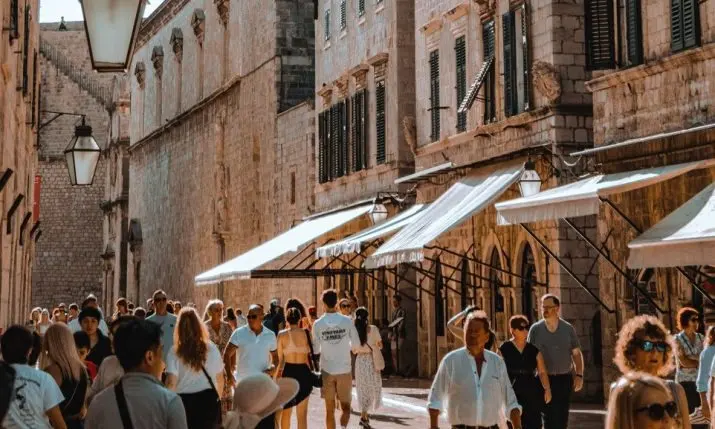
New Eurostat data confirms what anyone who has tried to find a parking spot in Split in August already suspects: Croatia is the most tourism-intensive country in the European Union. In 2025 the country averaged 24.5 overnight stays in tourist accommodation per resident, comfortably ahead of Malta on 21.7 and Cyprus on 19.4. Greece (15.1) and Austria (14.6) round out the top five.
The metric — nights spent in rented tourist accommodation divided by population — is more than a quirky statistic. It doubles as a gauge of how much pressure visitors place on local communities, and Croatia's score is roughly three and a half times the EU average of 7.0. At the other end of the table, Romania (1.6) and Latvia (2.7) see comparatively few tourist nights relative to their populations.
Zoom out and the wider picture is one of steady growth. EU tourist accommodation recorded 3.1 billion overnight stays in 2025, up 4.1% on 2024's three billion and 26.5% higher than a decade ago. Nearly 81% of those nights came from domestic travellers and other EU nationals — Europe holidaying within Europe — with a further 10.4% from elsewhere on the continent.
Long-haul markets are the interesting mover, though. Guests from the Americas accounted for 155.5 million nights (4.9% of the total), and their stays have more than doubled since 2015, up 101.9%. Asian visitors added 81.6 million nights and posted the fastest year-on-year jump, up 15.4%, with African travellers close behind at +13.7%. Oceania and Africa remain small slices overall, at 0.5% and 0.4% respectively.
For travellers, the takeaways are practical. Croatia's popularity means the classic Dalmatian hotspots — Dubrovnik, Hvar, Split — are at their busiest and priciest in July and August, and the intensity figures suggest locals feel the squeeze. Shifting a trip to June or September usually means warmer-than-you'd-expect seas, easier bookings and a calmer pace. The same logic applies to Malta and Cyprus, which rank just behind Croatia.
The growth in Asian and African visitor numbers also hints at busier peak seasons ahead at Europe's marquee sights, so booking accommodation and timed entries earlier than you might have a few years ago is increasingly worthwhile.