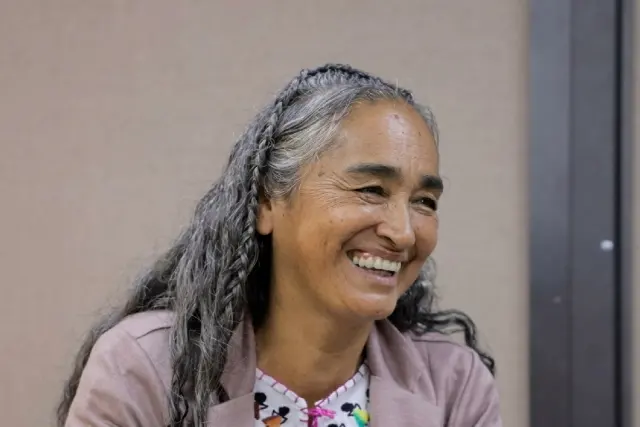
When the German teacher left Broulee Public School on the NSW south coast in 2000, nobody expected the vacancy to spark a language revival. But Kerry Boyenga, an Aboriginal teacher in her early 60s, had an idea: why not teach Dhurga, the language of her Yuin ancestors, instead of another European tongue? That swap set in motion one of Australia's most encouraging Indigenous language comebacks.
Dhurga is one of a cluster of closely related languages spoken along the NSW east coast at the time of British settlement in 1788. Speakers became known as the Yuin people, or Black Duck people, whose 13 traditional tribal groups stretch from Botany Bay and Campbelltown down to the Victorian border. Like so many First Nations languages, Dhurga was actively suppressed under colonisation. Boyenga remembers her fluent grandmother being forbidden from teaching children the language, with the threat of family separation hanging over anyone who used it. For much of the 19th and 20th centuries, Dhurga went dormant.
The turnaround started small. Broulee Public teamed up with Vincentia High School, about 130km north, and the two schools won grants from the NSW Department of Education and the Board of Studies. Aboriginal linguist Jakelin Troy ran a workshop at AIATSIS in Canberra, and researcher Jutta Besold was hired to trawl archives — including files at the South Australian Museum, with community consent — for surviving records of the language. In 2020, the work paid off: Kerry, her brother Waine, sister Patricia and other experts published the first Dhurga dictionary. The siblings now teach the language at schools and TAFEs across Yuin country, with online courses reaching Yuin people living far from their traditional lands.
The language itself has some charming quirks for learners. Dhurga uses six vowels in short-and-long pairs, where long vowels are essentially stretched-out versions of the short ones. Certain consonants like d/dh and n/nh sound similar to English ears, but the spelling is a built-in cheat sheet: an 'h' means your tongue goes to your teeth, while a 'j' adds a y-sound. Stress always falls on the first syllable, making pronunciation refreshingly predictable.
For travellers, this story adds a rich layer to any visit to the NSW south coast — the beaches, forests and towns from Wollongong down to Eden sit on Yuin country where these 13 tribal groups have lived for millennia. And it's not just a history lesson: anyone can enrol. TAFE offers Certificates I, II and III in Dhurga, open to the wider community as well as local Indigenous people.
Why does this matter to a holidaymaker? Because language is the front door to culture. Growing numbers of Aboriginal-led tours, cultural experiences and place-name stories along the south coast connect back to this revival — hearing Dhurga words spoken on their own Country is a completely different experience from reading about them. If you're planning a trip through Batemans Bay, Moruya, Bega or Eden, learning a few words (and remembering that first-syllable stress) is a small but meaningful way to engage with the oldest living culture on Earth. The whole story is a reminder that Australia's south coast isn't just scenery — it's a living cultural region, and its original languages are being spoken again.