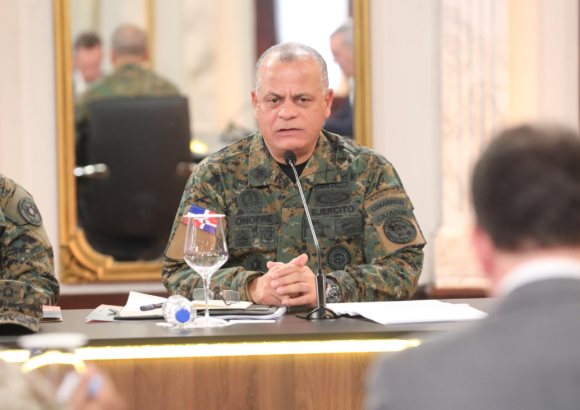
The Dominican Republic has put 11,000 soldiers along its border with Haiti, and its Defence Minister says the frontier has never been more tightly watched. Speaking on the programme LA Agenda Semanal, Lt. Gen. Carlos Fernández Onofre framed the build-up as an unprecedented modernisation of the Armed Forces, spanning land, sea and air approaches.
The headline project is the so-called intelligent border fence. So far, 54.5 kilometres have been finished, with another 13 kilometres under way plus a 14-kilometre stretch at Jimaní, one of the main official crossing points. In December the government expects to open a continuous 38-kilometre section running from Manzanillo to Capotillo.
This is not just concrete and fencing. The system is wired into the Ministry of Defence and its C5i command centre via fibre-optic cables, with solar-powered lighting, smart cameras, aircraft, naval patrols and autonomous drones. The ministry claims the setup allows round-the-clock monitoring and detects more than 90% of illicit activity along the line.
The wider military has also been kitted out: more than 1,400 vehicles added over six years, among them 21 Uro Vamtac armoured vehicles, plus trucks and patrol cars. Another 32 infrastructure projects are moving ahead between Montecristi in the northwest and Cabo Rojo in the southwest, including a new battalion HQ in Puerto Plata and an upgrade of the Montecristi military company to full battalion status.
Why should holidaymakers care? Most visitors fly into Punta Cana or Santo Domingo and never think about the Haitian border. But overland travellers doing the classic Hispaniola crossing between the two countries do pass through checkpoints like Jimaní and Dajabón, and these have been subject to periodic closures and tightened controls as security policy has shifted. Expect a heavier military presence, more document checks and potentially slower processing at crossings. If you are planning to travel overland between Haiti and the Dominican Republic, build in extra time, carry your passport, and check the latest border status before setting out, since crossings can close at short notice. For everyone else, the practical takeaway is simply reassurance: the areas most tourists visit are far from the border zone, and the government is signalling control and stability along it.
The build-up is part of a longer-running and often tense debate about migration and security on the island of Hispaniola, and it shows no sign of slowing. Travellers with plans in frontier towns such as Dajabón, known for its lively twice-weekly market, should stay aware that the security footprint there is changing fast.