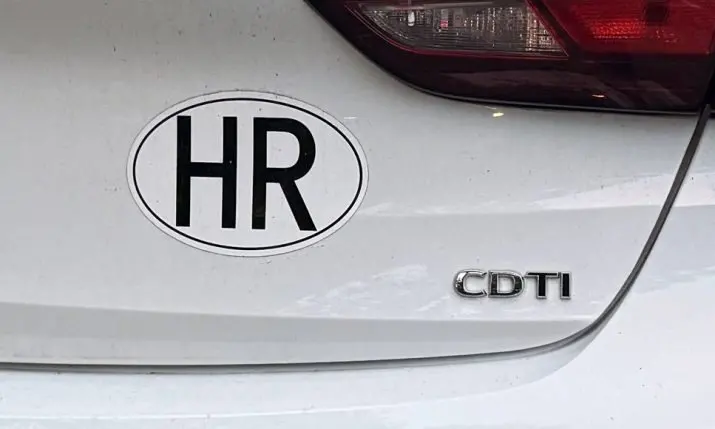
Planning to drive from Croatia into neighbouring countries this summer? A small white oval could save you a headache at the border. Croatian law requires many vehicles to carry the official HR distinguishing sign when travelling internationally — but whether you actually need one depends on your number plates and where you're headed.
The rules come from Croatia's Regulation on Vehicle Registration and Marking, and the Croatian Automobile Club (HAK) has spelled them out in its magazine, Revija HAK. The sticker is formally the distinguishing sign of the Republic of Croatia in international traffic, and it has a precise design: a white ellipse measuring 175 by 115 millimetres, with black HR letters 80 millimetres tall and a 10 millimetre stroke width. Anything else — decorative versions, tweaked designs, or stickers with slogans or advertising added — doesn't legally count, even if it says HR.
The good news for most drivers: if your car has the newer EU-style Croatian plates, with the blue EU band and the HR identifier on the left side, you're covered for travel anywhere within the European Union. No separate sticker needed. Millions of Croatian holidaymakers heading to Italy, Austria, Hungary or Slovenia can just drive.
It changes once you leave the EU. If you're crossing into Bosnia and Herzegovina, Serbia, Montenegro or other non-EU neighbours, you should display a separate HR sticker even if your plates are the modern EU type. Borders around the Balkans are busy in summer, and this is exactly where drivers get caught out.
The third group is cars with older Croatian plates that lack the blue EU band and HR identifier. Those vehicles need the sticker for any trip abroad, including to other EU countries. If you've bought a used car with old plates or have kept a set for years, it's worth checking before you pack the boot.
Why does this matter to travellers? Police in the region do check, and a non-compliant sticker can mean an awkward roadside conversation or a fine. It's a five-minute fix: buy a sticker that matches the official specification — correct size, correct lettering, nothing extra — rather than a novelty version from a petrol station souvenir shelf. If you're renting a car in Croatia for a cross-border trip, ask the rental company in advance whether the vehicle is properly equipped and whether cross-border travel is even permitted on your contract.
The takeaway is simple. Check your plates first. EU plates plus an EU destination means no sticker. Any trip outside the EU, or older plates anywhere abroad, means you need one that matches the official dimensions. Sort it before you leave, and the border crossing stays a formality rather than a drama.
Details via Croatia Week.