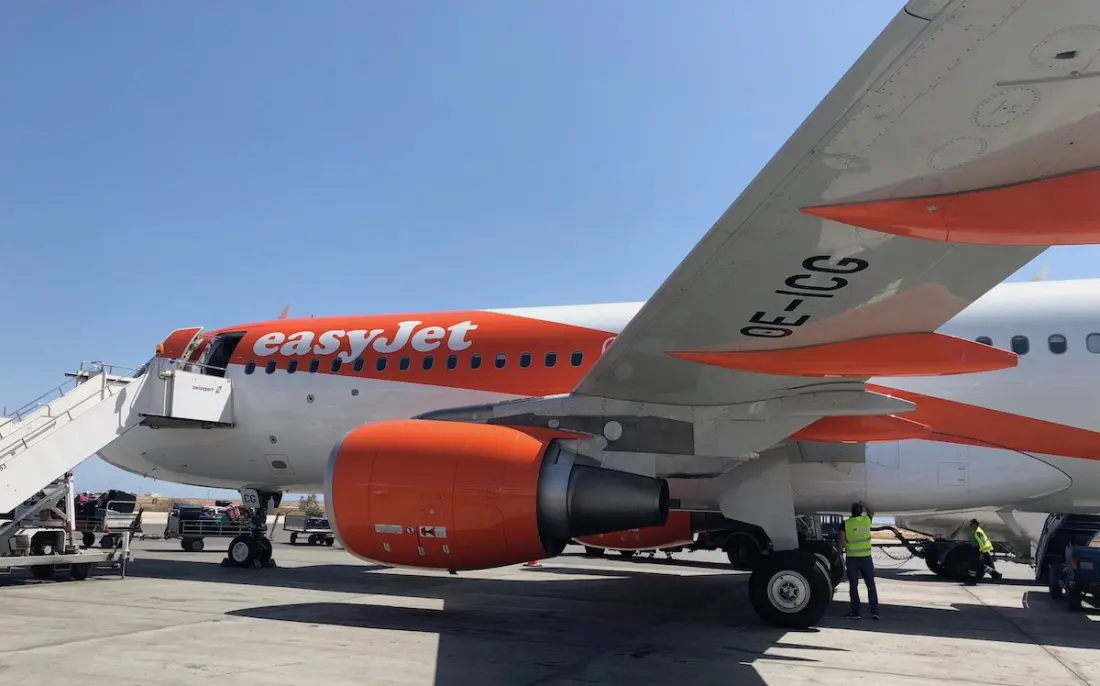
EasyJet has confirmed it will fit its fleet with Starlink satellite Wi-Fi, with installations beginning in the first half of 2027 and finishing by early 2028. For a carrier that currently offers zero onboard connectivity, jumping straight to Starlink — the fastest consumer internet available in the sky — is a big leap.
The rollout covers the aircraft that will stick around long-term: the airline's Airbus A320s, A320neos and A321neos across a fleet of more than 350 planes. The roughly 80 A319s in the fleet miss out, since they're all due for retirement by 2029. That means a full fleet with Wi-Fi won't be a reality until sometime in 2029, even though installations wrap up a year earlier.
The sting in the tail: pricing. Most airlines that have adopted Starlink — including several in the US — offer it to passengers at no charge. EasyJet's announcement is conspicuously silent on that point, and the expectation is that Wi-Fi will be a paid extra, or possibly free only for certain fare types or frequent flyer tiers. Given EasyJet's low-cost model, charging seems the likely default. The airline, for its part, frames the investment as a way to appeal to both holidaymakers streaming entertainment and business travellers who need to work in the air. CEO Kenton Jarvis has pitched connectivity as part of making travel "easy" and giving customers another reason to pick EasyJet over rivals.
There's also a competitive subplot worth knowing about. Ryanair, Europe's biggest budget airline and EasyJet's closest rival, has flatly refused to add Wi-Fi, with CEO Michael O'Leary arguing passengers won't pay for internet on an average one-hour flight. That stance prompted a public spat with Elon Musk earlier this year, complete with Musk threatening to buy Ryanair and the airline firing back with a "Big Idiot Seat Sale" aimed at "idiots on X." EasyJet's move puts direct pressure on that position — if travellers start choosing the connected option, Ryanair may have to reconsider.
For anyone who flies budget routes around Europe regularly, this genuinely matters. EasyJet flies to hundreds of destinations across the continent, and going from no connectivity at all to high-speed satellite internet changes what you can do on board — stream a film, answer emails, or keep the kids quiet on a two-hour hop to the Med. The caveats: don't book flights in 2026 expecting Wi-Fi, check whether your aircraft is an A319 before assuming you'll be connected through the late-2020s, and budget for a fee until EasyJet confirms otherwise. If free Starlink is the industry trend, expect pressure on EasyJet to follow — but nothing is promised.
Story via One Mile at a Time.