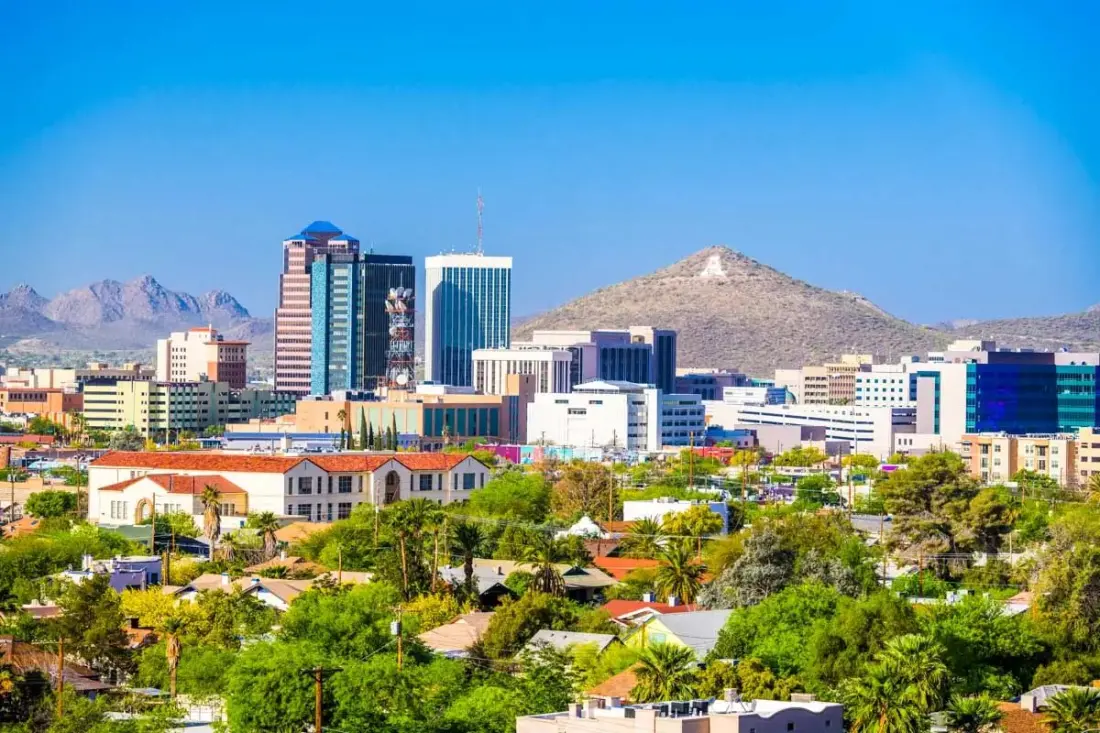
Most people drive through Tucson on their way to somewhere else. That's a mistake. Ringed by the Sonoran Desert and mountains, Arizona's second city packs giant saguaro cacti, a serious food scene and a surprising number of excellent museums into one very easy-going destination.
Start with the food, because Tucson's is genuinely distinctive. A four-hour downtown food tour covers six tastings at local spots, heavy on Southwestern flavours — the tamales come highly recommended — while doubling as a walking tour past landmarks like Hotel Congress and the Fox Tucson Theatre. It's a smart way to scout restaurants for the rest of your stay and get a quick primer on the cultures that shaped the city's cooking.
Then head outdoors. Saguaro National Park, split into two districts on either side of the city, is the headline act, and an e-bike tour of its paved 8-mile loop is one of the most efficient ways to see it — the electric assist flattens the hills and you cover far more ground than on foot. Riders should already be comfortable on a bike, and there's essentially no shade, so water and sunscreen are non-negotiable. If two wheels feel too energetic, a 90-minute horseback ride through Catalina State Park and Coronado National Forest offers the same scenery at walking pace, with views of the Santa Catalina Mountains. It books out weeks ahead, so reserve early.
For a change of pace, the museums are better than you'd expect. The Pima Air & Space Museum sprawls across 80 acres and six hangars with more than 400 aircraft, from a Wright Flyer replica to a Boeing 787. The Arizona-Sonora Desert Museum is harder to classify — part zoo, part botanical garden, part aquarium and art gallery — with 230 animal species and 1,200 plant types across 98 acres. Budget half a day; most visitors underestimate it.
Active travellers have plenty more: hiking at Sabino Canyon and Saguaro's two districts, a two-hour guided bike ride through the colourful adobe streets of Barrio Viejo (including the gloriously odd Rattlesnake Bridge, which you enter through a giant snake's mouth), rock climbing, and a scenic drive up Mount Lemmon to escape the heat — temperatures drop noticeably as you climb. As a dark-sky city, Tucson is also one of the best places in the US for stargazing.
A three-day visit could pair botanical gardens and the food tour with Barrio Viejo on day one, the air museum and an e-bike ride on day two, and horses plus the desert museum on day three. Two practical things to know: the city is spread out, so rent a car, and pack layers — desert nights get cold even when days are scorching. Between mid-June and September, monsoon storms roll in during the afternoons, so check forecasts before any outdoor plans.
Tucson suits travellers who like their cities outdoorsy and unpretentious — hikers, cyclists, food lovers and anyone who's ever wanted to ride through a rattlesnake-shaped bridge. It's an easy add-on to a Phoenix or southern Arizona road trip, and the kind of place that rewards an extra day or two.