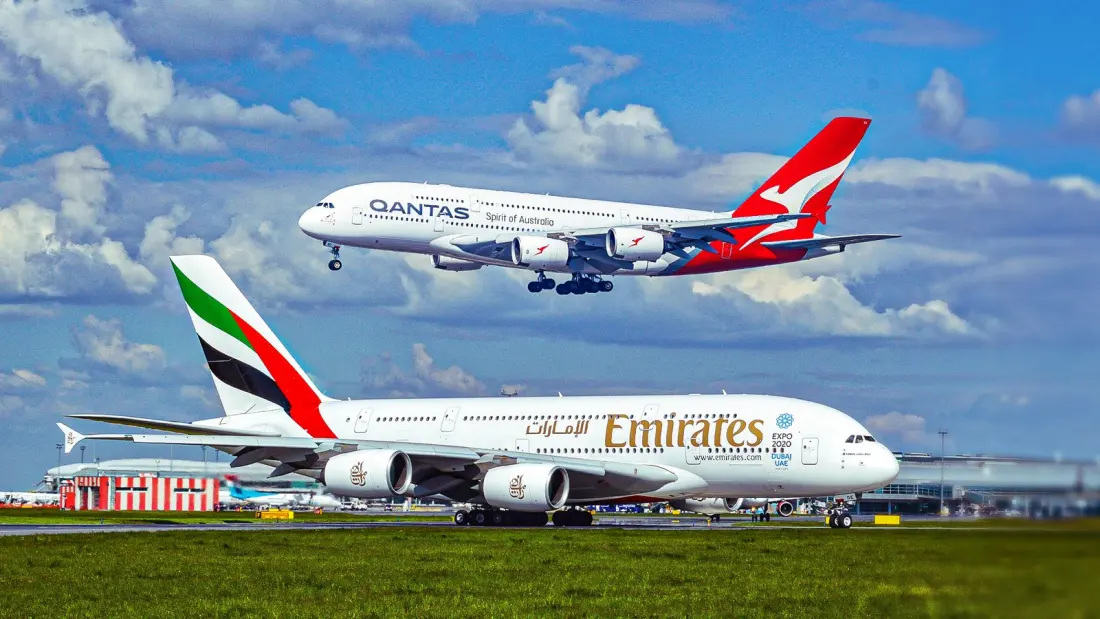
Two airlines, one aircraft, opposite strategies. Emirates is spending $5 billion gutting and rebuilding its Airbus A380 fleet — stripping each double-decker back to bare metal and refitting it inside and out — while Qantas has confirmed it will start retiring its ten Superjumbos from 2028, several years ahead of its original plan.
For Emirates, the maths is simple. President Sir Tim Clark has said the A380 was the most profitable asset in its fleet during its record-breaking 2025–26 financial year, when the airline posted a $6.6 billion profit. The Superjumbo's appeal lies in brute capacity: one flight can deliver hundreds of passengers to slot-restricted airports like London Heathrow, Amsterdam Schiphol and Sydney, where flying the same number of people on smaller planes would mean extra takeoff slots Emirates simply cannot get. The airline plans to keep its 116-strong fleet — the largest in the world by some distance — flying until 2041.
The retrofit programme, running since November 2022 out of Emirates' Dubai engineering hangars, is one of the biggest in commercial aviation history. Around 400 engineers have logged 4.4 million man-hours so far, with each A380 getting more than 4,000 new parts. The headline change for passengers is Premium Economy, appearing on the A380 for the first time in a 2-3-2 layout with legrests, adjustable headrests and 13.3-inch screens. Starlink WiFi is also being rolled out across the wider fleet. Just under half the Superjumbos have been through the workshop already, with work averaging 28 aircraft a year.
Qantas has reached the opposite conclusion. Rising jet fuel costs — which it estimated could have cost as much as AU$610 million before mitigation — have hit a four-engine fuel guzzler harder than most, and a wave of new long-haul aircraft is arriving to take over. Seventeen new planes joined the group last year, with up to 31 more coming, including the A350-1000ULRs earmarked for Project Sunrise non-stop flights. The A350-1000 burns roughly 25% less fuel than previous-generation aircraft and seats up to 480, while new Boeing 787s handle other long-haul routes. Neither matches the A380's raw capacity, but both make its running costs much harder to justify.
Why should travellers care? If you fly Emirates long-haul, the aircraft you board is increasingly likely to have a freshly rebuilt interior, and Premium Economy — long missing from the Superjumbo — is spreading through the fleet. If you're loyal to Qantas, expect more A350s and 787s on international routes from the late 2020s, and book the A380 upstairs suite while you still can. For aviation fans, it's a rare chance to watch one airline bet billions on the world's biggest passenger plane while another gracefully bows out.