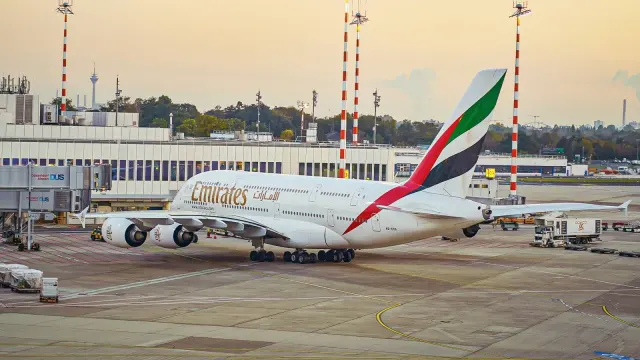
Emirates has reported a half-year profit before tax of AED 4.1 billion (roughly AU$1.58 billion) for 1 April to 30 September 2026 — down 66 per cent on the same period last year. The cause wasn't weak demand for the airline itself so much as a bruising operating environment: six months of Gulf regional conflict, intermittent airspace restrictions and travel advisories that rerouted traffic away from its Dubai hub, plus jet fuel costs that doubled.
Group revenue, spanning the airline and ground handler dnata, fell 12 per cent to AED 66.2 billion. Fuel is Emirates' biggest cost at 34 per cent of operations, and even after burning 12 per cent less of it, the pre-hedging bill jumped 60 per cent. A savvy fuel hedging programme clawed back AED 7.1 billion, limiting the net increase to 13 per cent — one reason the group stayed solidly profitable rather than slipping into loss.
Passenger numbers tell the disruption story: 21.8 million people flew with Emirates over the six months, down 22 per cent, and seats were 72 per cent full versus 79.5 per cent a year earlier. By 30 September the airline was back to 91 per cent of its pre-disruption network, serving 150 airports across 78 countries and territories.
For passengers, the more interesting news is what Emirates spent during the turmoil. It took delivery of nine new A350s, finished full cabin refits on 12 aircraft, and pressed on with a retrofit programme worth more than US$7 billion to roll out its latest cabins fleet-wide. Two new touches debuted: a U-dream headrest built into Economy seats and electronic privacy dividers in Premium Economy. Another 36 aircraft gained Starlink Wi-Fi, bringing the connected fleet to 57. The airline also leaned on traveller-friendly policies — travel cover that applies regardless of government advisories, free date changes and broader refund options — designed to keep people booking through Dubai even when headlines wobble.
Chairman and CEO Sheikh Ahmed bin Saeed Al Maktoum called it a "demanding six months" but pointed to firm customer demand and a strong cargo contribution, saying the group enters the second half of its financial year with "measured optimism" and a healthy cash position.
Why should travellers care? Because a profitable Emirates is one that keeps flying the routes, refreshing the cabins and upgrading the Wi-Fi. If you've been hesitating to book a Dubai connection because of regional unrest, the airline is now operating 91 per cent of its normal network and has advisory-proof travel cover and free date changes on offer — practical buffers if plans change. Frequent flyers on Australian routes also have something to toast: Emirates recently celebrated 30 years of flying to Australia with a Melbourne event and an anniversary menu built on local produce, now appearing on flights and in lounges nationwide. Reported by Karryon.