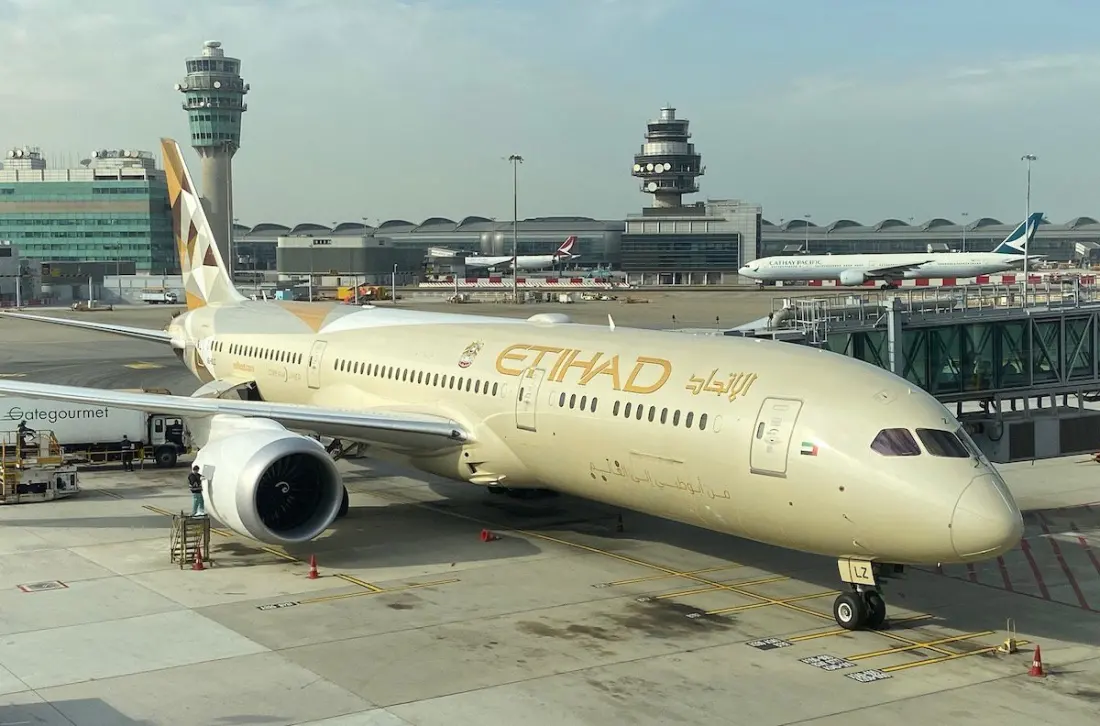
A routine taxi after a long-haul landing turned into a runway incursion at Boston Logan International Airport, and the whole thing was caught on air traffic control audio. An Etihad Boeing 787-9 operating flight EY7 from Abu Dhabi had just touched down when it rolled across a runway it had been explicitly told to hold short of — and the pilots had read the instructions back correctly only moments earlier.
The details: controllers cleared the aircraft to taxi via taxiways R and N and hold short of runway 4L, which was in use for arrivals at the time. The readback was accurate. But as the widebody approached the 4L/22R runway, it simply kept going. The controller spotted it instantly, ordered the Etihad jet to stop, and sent a Republic Airways regional jet on approach around for another landing attempt. In the audio, the Republic pilot — chirpy, almost golden-retriever enthusiastic about radio protocol — acknowledges the go-around without drama.
What happened next is arguably the most interesting part. There was no shouting match and no lecture. Controllers kept the frequency calm, got the Etihad crew taxiing again, and once the aircraft neared the ramp, handed over a phone number to call regarding a possible pilot deviation. That's the standard, low-drama way the FAA flags these events for review — a contrast with the sharper-tongued handling you might hear at other busy US towers.
Why did it happen? That's genuinely unclear. There were four pilots in the cockpit of a 787-9, and nobody appears to have registered that the taxi route crossed an active arrival runway. One theory: the aircraft approached from the 22R side, and the crew failed to connect the dots that this was the same pavement they'd been told to hold short of on the 4L side. Confusing? Yes. Excusable for a heavy jet? Not really.
How risky was it? Probably less than the headline suggests. The regional jet was still airborne, and unless it had badly overrun its touchdown point it was unlikely to reach the section of runway where the 787 was crossing. Controllers often send arriving traffic around in these situations out of pure caution. Still, a widebody entering an active runway without clearance is a serious event by any measure, and the readback-then-ignore pattern makes it stranger — the pilots demonstrably heard the instruction and didn't process it.
For travellers, the takeaway is reassuring rather than alarming: the system worked exactly as designed. A controller caught the error within seconds, the arriving jet went around safely, and nobody was ever in real danger. Go-arounds like this are routine safety tools, not near-misses in the movies sense. If you're flying into Boston or connecting through Logan, expect business as usual — and if you're on Etihad's Abu Dhabi route, this incident is worth a shrug more than a rethink, pending whatever the deviation review turns up. Hat tip to the controller who stayed calm and on top of it.