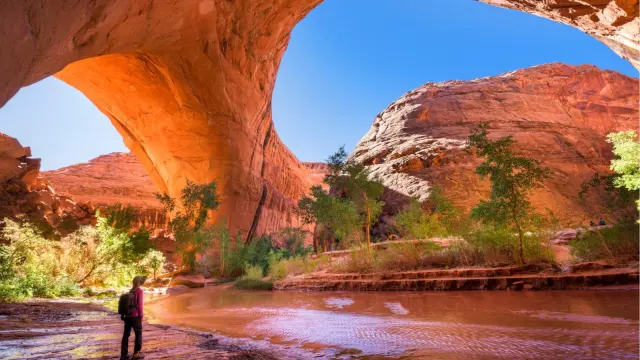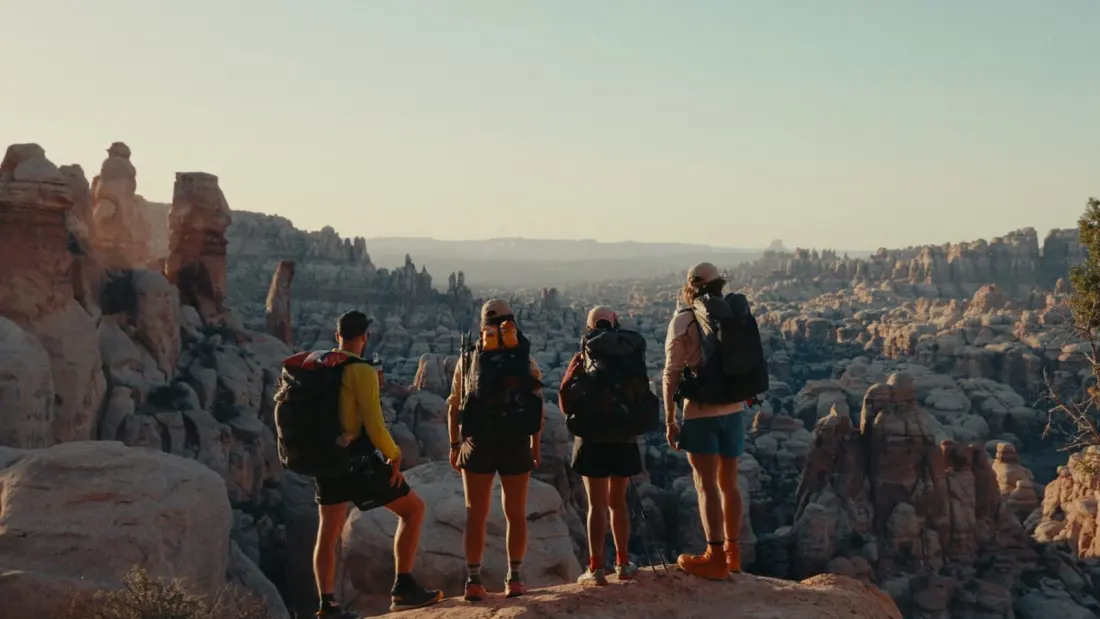
There's no trail to follow on the Hayduke. The 800-mile route threads through the canyon country of southeast Utah and northern Arizona, and it's famous for a reason: hikers route-find their own way across slickrock, through slot canyons and along rivers that don't always play nice. In 2023, four thru-hikers — Andy Laub, Elina Osborne, Zelzin Aketzalli and Peter Hochhauser — walked it carrying four cameras between them, right after a record snow year that had the region under a state of emergency as meltwater surged through the canyons.
Three years later, that trip has become HAYDUKE, a four-part docuseries streaming on Camel's Cabana, co-directed by Laub and Osborne. In a new interview with The Trek, the pair unpacked how a mountain of footage — 20 terabytes, hundreds of hours — became a finished series.
The drama wasn't staged. In one sequence, Aketzalli gets caught in quicksand in the Escalante while Hochhauser, trying to pull her free, starts sinking too. The team had an agreement: help if you can, film if you can't, so the moment runs unbroken for nearly a minute. The group deliberately withheld most place names in the series — partly to protect fragile terrain, partly to keep the story anchored in experience rather than a map.
Laub, who previously filmed the Pacific Crest Trail documentary As It Happens and THRU: The Pacific Northwest, says the Hayduke was different because there was no path to lean on. He carried 8-9 pounds of camera gear on the hike, and describes the constant push-pull of documenting versus simply walking: the hike comes first, the camera second. The post-production was arguably harder than the walking. Reviewing the footage took six months and produced a nearly 300-page outline; the first cut was feature-length, but the team felt it stripped out too much character. Doubling the runtime into four episodes let each hiker's arc breathe, including Osborne's writing about the loss of her mother, which became central to the narration.
For travellers, the Hayduke sits at the extreme end of American long-distance hiking — no marked tread, serious route-finding, limited water, and canyon country that turns dangerous when snowmelt is high. It's a reminder that the Southwest's red rock country can demand expedition-level respect even from experienced hikers. For everyone else, the docuseries is a rare window into what a genuinely unmarked route looks and feels like, filmed from inside the group rather than from a drone's distance. If it plants an itch, the sensible entry points are the region's established hikes around Canyonlands, Capitol Reef and the Escalante, where you can sample that same terrain without committing to 800 off-trail miles.
Walking it took months. Turning it into a story took three years. As Osborne puts it, finally releasing it is an exhale.