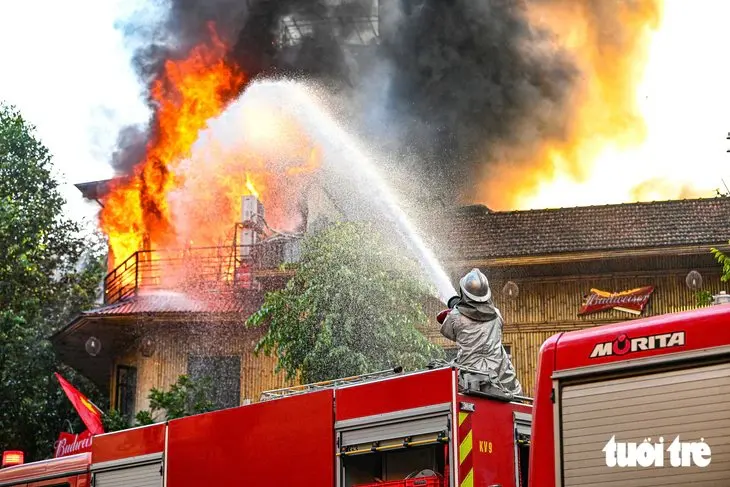
A restaurant in central Hanoi went up in flames late Thursday afternoon, but there was one piece of good news: everyone inside made it out.
The blaze started around 4:40 PM at 14 Tang Bat Ho Street in Hai Ba Trung Ward, a busy district just east of the Old Quarter. The premises were operating as a food and beverage venue, and its timber-heavy exterior cladding appears to have worked against it. Witnesses said flames first broke out on the rooftop terrace on the third floor, then spread rapidly down the wooden facade.
People inside — both diners and staff — scrambled to evacuate as the fire took hold. Neighbours reported several loud explosions as the blaze ripped through the building, likely gas canisters or other combustibles stored on site.
Fire and rescue crews from Regional Units 7 and 9 responded quickly, with five fire engines on the scene and police directing high-pressure hoses at the flames. By about 5:00 PM — roughly twenty minutes after the alarm — the fire was under control. Preliminary reports confirmed no casualties, though the restaurant itself was completely gutted. Authorities are still investigating what caused it.
For travellers, the takeaway is less about one building and more about a pattern worth knowing. Vietnam's cities, Hanoi included, are full of narrow tube houses and compact restaurant buildings with wooden balconies, open terraces and improvised kitchens, often with limited escape routes. Serious restaurant and bar fires are rare, but they do happen — most recently the 2023 mini apartment fire in Hanoi that killed dozens. When you're heading up to a rooftop bar or a third-floor dining room, it's worth a quick mental note of the stairs. And if you hear a loud bang in an alley of gas cylinders, take it seriously.
None of this should put anyone off Hanoi, which remains one of Southeast Asia's best eating cities — think bun cha on plastic stools, bia hoi at corner tables, and a restaurant scene that evolves by the month. Incidents like this one are dramatic but localized: the surrounding streets, the nearby train street, and the whole Old Quarter carry on as normal. The fast response time here — crews containing a major fire in under half an hour — is actually a reasonable indicator of how seriously the city's emergency services now take these events.
The practical lesson for visitors is simple. Choose busy, well-reviewed venues, glance at where the exits are in older multi-storey buildings, and don't linger near gas storage areas. Then get back to the spring rolls.