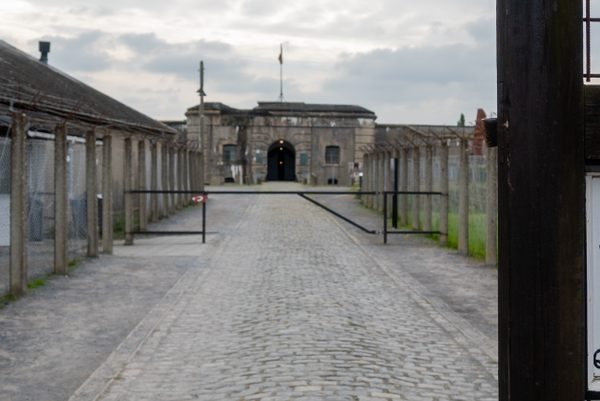
Just outside Willebroek, a short drive south of Antwerp, sits one of Belgium's most sobering WWII sites: Fort van Breendonk. Built between 1906 and 1913 as part of the country's defensive ring, this fortress ended up serving in both world wars — but it's its role under Nazi occupation that visitors come to confront today.
During WWII the fort operated as a transit camp and prison for political prisoners, resistance fighters and Jewish detainees. It held 3,590 prisoners in total. Unlike the vast extermination camps, Breendonk was notorious less for mass killing on site than for its cruelty and degradation: torture, forced labour and terror were routine. Of those held there, 303 died inside the fort and 1,741 were later killed in other camps to which they were transported. Allied forces liberated the camp in September 1944.
Conditions were claustrophobic by design. At times there were more SS guards than inmates, so prisoners lived under constant surveillance. Camp commander Philipp Schmitt became infamous for setting his German Shepherd, Lump, on detainees — one prisoner bled to death after 14 bites. Punishments went beyond beatings: men were thrown into the moat surrounding the fort, or buried up to their heads in soil while guards hurled mud at their faces. Deaths were routinely recorded as heart failure or old age.
Today the fort is preserved as a national memorial and museum. You move through a maze of corridors and cells — the torture room, the showers, the barracks — with an audio tour that reconstructs what daily life was like for prisoners. Exhibitions and information panels throughout the building add context, and the audio guide is included in the admission price.
Fair warning from those who've been: this is a heavy visit. Gallows nooses and coffins are part of the exhibition and are hard to avoid as you move through the spaces. That's deliberate — Breendonk doesn't soften anything. If you're travelling with children or anyone sensitive to graphic material, think it through beforehand.
For travellers interested in WWII history, this fills a gap between the better-known sites. It's compact enough to visit in half a day from Antwerp or Brussels, parking sits right at the lane leading to the fort, and the intimate scale — you can stand in the actual cells — makes the history land in a way larger camps sometimes can't. Pair it with the National Memorial at nearby Kazerne Dossin in Mechelen for a fuller picture of the deportation of Belgian Jews.
Original source: Atlas Obscura