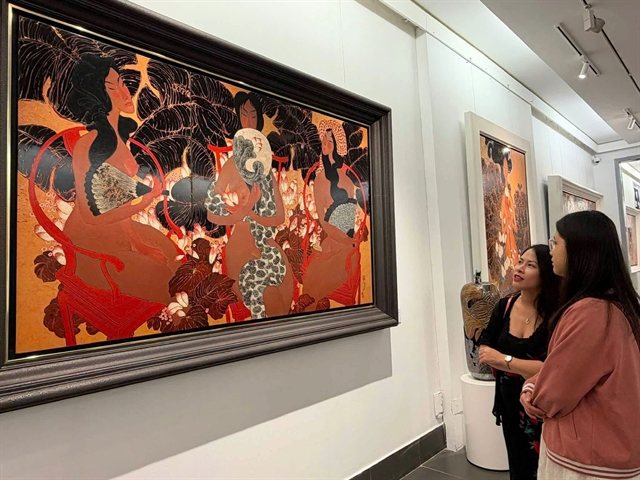
Right now, one of the most interesting reasons to step inside the Việt Nam National Fine Arts Museum isn't the permanent collection — it's a temporary show of more than 50 large-scale lacquer paintings by Nguyễn Hoài Hương, a 70-year-old HCM City artist whose work is drenched in memories of the Vietnamese north.
The exhibition, titled "Thu An Thường" (Peace Garden in Autumn), runs through November 28 at the museum on Nguyễn Thái Học Street in Ba Đình, a short walk from the Hồ Chí Minh Mausoleum complex. Hương was born in Hải Phòng but built his career in the south after graduating from the HCM City Fine Arts University in 1986, and the show is essentially a love letter to a homeland he left behind. Golden haystacks, banana and lotus leaves, the sloped roof of a village communal house — the visual vocabulary of the Red River countryside — rendered in a muted palette of purples, blues, greens, earth browns and lime yellow.
What makes it worth a traveller's time is the medium as much as the subject. Lacquer painting is a distinctly Vietnamese art form, built up in layers on vóc (a prepared wooden board) using eggshell, black lacquer, gold and silver leaf. Hương trained in oil painting but chose lacquer for its local roots, and he's known for pushing the traditional materials in fresh directions. His works sit in the HCM City Fine Arts Association collection and private collections in Vietnam and abroad, and he's also worked as a designer on interior and exterior projects. Musician Dương Thụ, quoted by the museum circuit, compared his paintings to instrumental music — something you take in for stillness rather than meaning.
Even if contemporary art isn't usually your thing, the show doubles as a crash course in a craft you'll see everywhere in Vietnam, from temple panels to souvenir-shop screens, and rarely at this scale or quality. The museum itself is a handsome French colonial building with one of the country's best survey collections, so pairing the temporary exhibition with an hour of browsing is an easy, low-cost culture stop in the middle of a Hà Nội itinerary. Go in the morning, then walk down to the Temple of Literature or over to Văn Miếu street's cafés for the full Ba Đình afternoon.
For art lovers, designers and anyone curious about how Vietnamese tradition meets modern sensibility, this is a time-limited window: once November 28 passes, the paintings return to private hands.