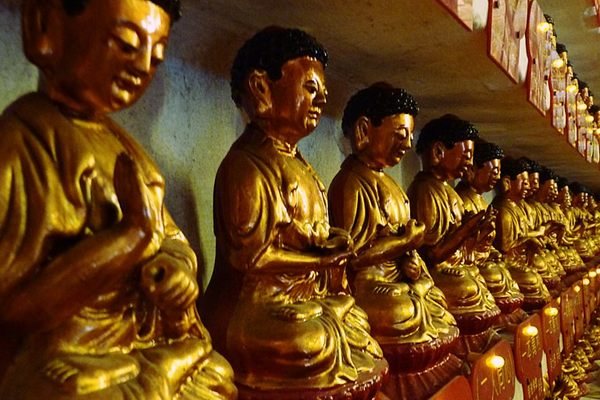
The name undersells it. Hong Kong's Ten Thousand Buddhas Monastery actually holds more than 12,000 Buddha statues — and it isn't technically a monastery at all, since no monks live there. A team of laypeople runs the temple complex day to day.
The site sits on a wooded hillside above Sha Tin in the New Territories, looking down on what is now dense urban development. When construction started in 1948, the hill overlooked the small village of Pai Tau and its farmland. The complex was finished in 1957, the same year the Sha Tin Hui market township opened on the unused fields below. That township survived until the late 1970s, when it was demolished to make room for the Sha Tin New Town development — which is why the monastery now serves as a quiet pocket of greenery on the edge of a sprawling town.
Spread across eight hectares, the complex includes five temples, four pavilions, a verandah and a nine-storey pagoda. Among the deity statues on display is the strangest sight of all: the gold-covered embalmed body of the monastery's founder, Yuet Kai, exhumed eight years after his burial and kept as a relic.
The climb itself is a big part of the appeal. The concrete path up is flanked by around 500 life-size gilded Arhat statues, two per side, each frozen in a different pose. They were made from fibreglass by artists from Yunnan and Guangdong provinces, painted bright gold, and give the steep ascent a strangely meditative quality. Fair warning: the trail involves more than 400 stairs, and some stretches are genuinely steep.
Getting there is simple. From Sha Tin MTR station, take exit B, walk down the long pedestrian ramp toward the Homesquare shopping centre, turn onto Pai Tau Street, then follow Sheung Wo Che Road to the trailhead. Entry is free, and the site is open daily from 9am to 5pm. There's a small vegetarian eatery on site if you need refuelling after the climb.
One practical tip from those who know the route: ignore anyone on the lower path dressed as a monk asking for donations — they're not the real thing.
For travellers, this is a half-day trip that combines light exercise, eccentric religious art and skyline-adjacent tranquillity, all a short MTR ride from central Hong Kong and without spending a cent on admission. It suits anyone who likes their sightseeing with a bit of a workout — just wear decent shoes and bring water for those stairs.
Credit: Atlas Obscura