
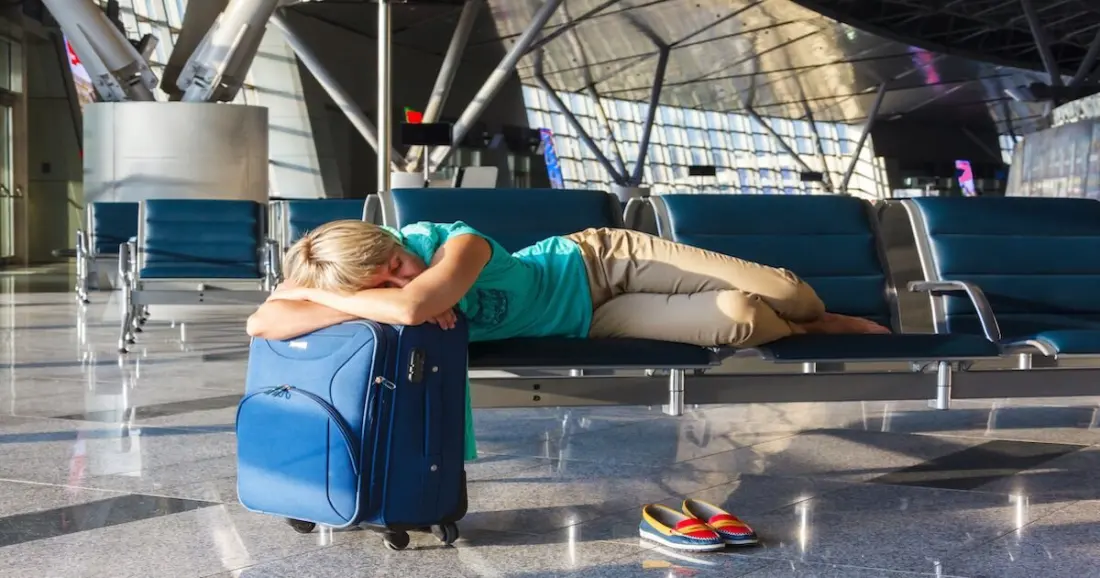
Delayed overnight, facing a 6am connection with no hotel budget left? Sleeping in an airport is a rite of passage for budget travellers, and it's far more survivable if you know what you're doing. Few people know it better than Donna McSherry, editor of SleepinginAirports.net, a site that has spent years crowd-sourcing reviews of which terminals welcome sleepy passengers and which kick them out at midnight.
The core problem is that airports are actively hostile to rest. Designers want you awake and spending: bright white lighting, hard bench seating with armrests in every seat, constant boarding announcements, and a background hum of cleaning machines and announcements that never quite stops. So the first move is strategic — don't assume your departure gate is your best option. Some terminals have quiet zones, darker corners, carpeted areas, or rows of armrest-free benches. Others have airport hotels or pay-per-use lounges where a few dollars buys a recliner, Wi-Fi and a shower, which can beat a hard floor for a fraction of a night's hotel rate.
Where you sleep matters as much as whether you're allowed to. The advice from seasoned airport sleepers is blunt: find a spot that's visible but out of the main foot-traffic flow, keep your luggage strapped to you or zipped under your body, and use your bag as a pillow only if you're comfortable losing it. Earplugs and an eye mask are the two cheapest upgrades in travel — they neutralise the announcements and the lighting, which are the biggest sleep-killers. A sarong or oversized scarf doubles as a blanket, since terminal air-conditioning is calibrated for crowds, not for someone lying still for six hours.
The 'getting away with it' part of the equation is mostly about respecting the rules of the specific airport. Security in some countries is fine with overnighters; elsewhere, sleeping passengers get woken and asked for a boarding pass, or terminals shut entirely between the last arrival and first departure. Checking an airport's overnight situation in advance — the whole premise of SleepinginAirports.net's reviews — saves you from a nasty 2am surprise. It's also worth knowing that some airports have quietly improved in recent years, adding rest zones with reclining lounge chairs specifically because long layovers are now so common.
Why should a regular traveller care? Because the alternative to a rough airport night is often a last-minute hotel at surge pricing, or a genuinely unsafe microsleep at the wheel of a rental car on the way to an airport motel. A bit of preparation — a kit with earplugs, an eye mask, and a plan for where you'll bed down — turns an ordeal into a mildly boring few hours. It's especially relevant for anyone flying budget carriers on early departures, backpackers on long multi-leg routings, and families stuck with cancellations who'd rather not blow the holiday budget on an emergency room.
Sleeping on a concourse will never rival a hotel, but with the right spot, the right gear and a little research, it can be the difference between a wrecked trip and a workable one.
Reported by Matador Network, drawing on the expertise of SleepinginAirports.net.