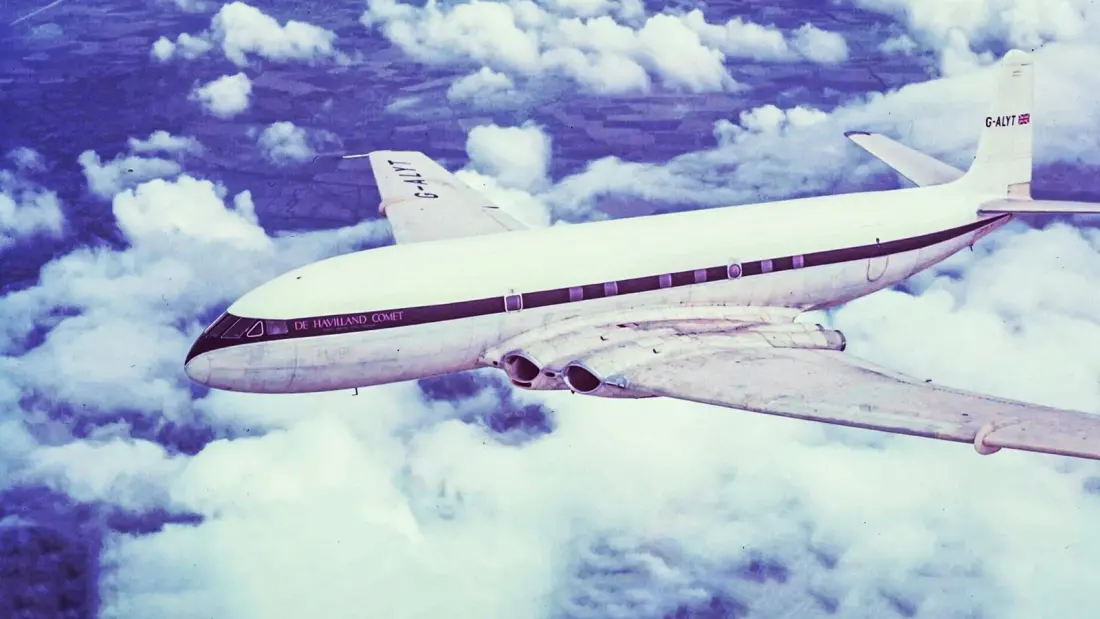
Before the Boeing 707 or the DC-8, there was the de Havilland DH.106 Comet — the world's first commercial jet airliner, built in Britain between 1949 and 1964. With four engines tucked into its wing roots and a pressurised cabin, it looked like nothing else in the sky and briefly made the UK the centre of the aviation world. The story of how it rose and fell is one of aviation's great cautionary tales.
The idea took shape during the Second World War, when the Brabazon Committee called for a pressurised transatlantic mail plane. Sir Geoffrey de Havilland pushed for a turbojet-powered design when most experts doubted jets were reliable enough. BOAC ordered ten aircraft, designer Ronald Bishop's team abandoned a radical tailless concept when capacity grew from 24 to 36 seats, and the DH.106 Comet name was settled in December 1947. The prototype flew 31 minutes from Hatfield in 1949, piloted by former RAF night-fighter ace John 'Cats Eyes' Cunningham.
In service, the Comet was spectacular. In 1952, 'Yoke Peter' carried the first paying jet passengers from London to Johannesburg — 17 hours 16 minutes, roughly twice as fast as piston aircraft. London-to-Tokyo took 36 hours versus more than 86 on BOAC's Argonauts. By summer 1953, eight Comets left London weekly for Johannesburg, Tokyo, Singapore and Colombo, and the jet stayed profitable at load factors as low as 43%. Prince Philip even flew home from the 1952 Helsinki Olympics on one.
Then the disasters began. After a string of crashes — including BOAC Flight 781, which broke apart near Rome in 1954 — the Royal Aircraft Establishment at Farnborough found the culprit: repeated pressurisation cycles caused metal fatigue cracks around the windows, hatch corners and antenna cutout, tearing the thin-skinned fuselage apart mid-flight. In total, the Comet suffered 25 hull losses, 13 of them fatal, killing 492 people. Churchill demanded the mystery be solved regardless of cost — and the findings reshaped aircraft engineering forever.
The redesigned Comet 4 returned in 1958 and even beat everyone to the first nonstop jet transatlantic crossing, London to New York in 6 hours 12 minutes. But Boeing and Douglas had arrived with bigger, faster, longer-range aircraft. Britain's head start was gone. The final Comet flight came on 9 November 1980, when a Dan-Air Comet 4C flew from Gatwick with low passes over Heathrow and RAF Brize Norton before heading to a museum in Hermeskeil, Germany. One research Comet, XS235, kept flying until 1997 and now sits in the Cold War Jets Collection at Bruntingthorpe, Leicestershire.
For aviation-minded travellers, the Comet is worth knowing about — not just as history, but because preserved examples are scattered across the UK, from Bruntingthorpe to the Science Museum, and the aircraft's lessons still shape every jet you board today. Anyone flying between Europe and Africa or Asia on a modern jetliner is following routes the Comet pioneered seven decades ago.
Story via Simple Flying.