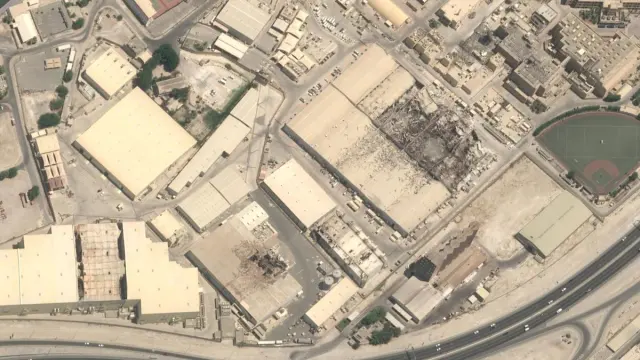
Bahrain woke to air-raid alerts on Saturday after Iran launched missiles and drones at the small Gulf kingdom, hitting a civilian industrial facility and targeting American military positions. Two people were hurt: a Pakistani resident left in critical condition and a Bahraini citizen whose injuries were described as stable. Civil Defence teams spent the day tackling a fire at the struck site, though officials did not name its location.
Bahrain's Defence Force said its air defences intercepted several incoming attacks, with falling shrapnel causing damage but no further casualties. The government had earlier pushed alerts urging residents to shelter, issued an all-clear, then sent a second warning as the situation evolved. Tehran's Revolutionary Guard claimed the assault, saying its aerospace forces struck US positions at the al-Riffa and Awali bases in retaliation for what it called repeated violations of Iranian airspace. US Central Command did not immediately comment. Bahrain hosts the US Navy's Fifth Fleet, which makes it a recurring target in the conflict.
This is not an isolated incident. Bahrain says it has intercepted multiple Iranian attacks in recent days, and Gulf Arab states have been repeatedly hit since the US and Israel attacked Iran in February. What began as a bilateral war has steadily pulled in neighbouring countries — a serious concern for the region's travel and tourism sectors, which had spent years positioning the Gulf as a safe, easy-connectivity hub for global travellers.
For anyone with trips booked to Bahrain or nearby, the practical picture is straightforward: the security environment is volatile and changing by the day. Airlines may reroute or cancel flights into Gulf airspace at short notice, and governments including the UK and US regularly update their travel advisories for Bahrain and the wider region. Anyone travelling soon should check their foreign office guidance, monitor airline notices, and consider whether flexible or refundable bookings make sense for now.
Travellers already in Bahrain should register with their embassy if their country offers it, follow local Civil Defence alerts, and know the location of shelters in their hotel area. The kingdom is small — most points are within an hour's drive — so an all-country alert applies broadly, not just to specific districts.
There is no sign yet of when the escalation cycle will pause. Until it does, leisure travel to Bahrain remains a decision to make with eyes open, weighing insurance cover, flight flexibility and the latest official advice rather than pre-war assumptions about one of the Gulf's most compact and historically welcoming destinations.