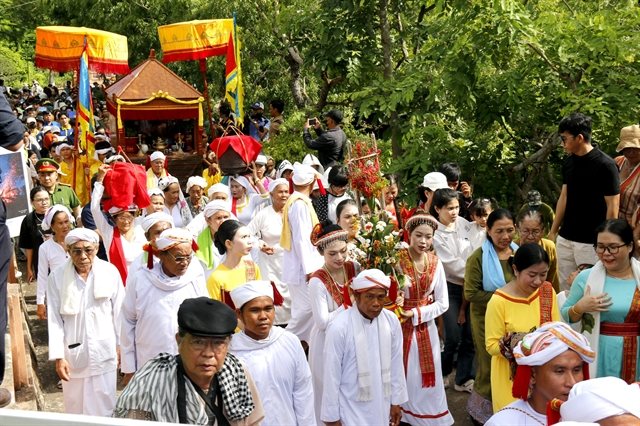
For three days each seventh lunar month, the Chăm people of south-central Vietnam hold their largest and most important celebration: the Katê Festival. This year's edition ran from October 9 to 12 across two provinces, Lâm Đồng and Khánh Hòa, with thousands of Chăm people in colourful traditional dress taking part in rituals, processions and performances that have earned national heritage status.
Katê is rooted in the Balamon religion, a form of Hinduism practised by the Chăm. It's a time to give thanks to kings, mandarins and ancestors, and to pray for good harvests, health and prosperity. One of the festival's most striking moments is the procession of the sacred costume of Goddess Po Inu Nagar, revered as the Mother of the Land, credited with teaching the Chăm farming, weaving and animal husbandry. In Khánh Hòa, the main ceremonies at Po Klong Garai Tower in Đô Vinh Ward and Po Rome Tower in Phước Hữu Commune included opening the tower doors, bathing the deity statues and presenting food offerings, while younger generations played ginăng and paranưng drums and the saranai wind instrument, and performed folk dances.
In Lâm Đồng, the action centred on the Pô Sah Inư Chăm Towers on Bà Nài Hill in Phú Thủy Ward, under the theme of preserving and promoting Chăm heritage. Beyond the religious ceremonies, organisers put on folk dances, traditional music, a costume fashion show and folk games designed to give visitors a proper introduction to Chăm culture. The province's Chăm Cultural Centre in Bắc Bình Ward staged a demonstration of the thanksgiving ceremony, live brocade weaving and pottery making, plus an exhibition of Chăm antiques.
The festival was recognised as national intangible cultural heritage by Vietnam's Ministry of Culture, Sports and Tourism in 2022, and Khánh Hòa is now working on a project to protect and promote Katê through to 2030, deliberately linking heritage preservation with tourism. Officials in both provinces framed the festival as both a religious occasion and a way to celebrate the region's ethnic diversity — Lâm Đồng alone is home to 49 ethnic groups.
For travellers, Katê is a rare chance to see a living religious tradition in genuinely atmospheric surroundings. The Chăm towers where the rituals take place are centuries-old Hindu-era monuments, and visiting during the festival means you'll experience them filled with music, offerings and crowds rather than as quiet ruins. If you'd rather avoid the crowds, the towers are fascinating year-round, and the Chăm Cultural Centre's craft demonstrations offer a taste of the same traditions in a calmer setting. Just note that the lunar calendar means dates shift each year — check the seventh lunar month against the solar calendar before booking.