Kombucha has quietly become easy to find in Costa Rica. The fizzy, tart fermented tea now shows up at ferias (farmers' markets), health-food shops and a growing number of cafes, especially in beach towns and the Central Valley. If you've seen bottles at a Saturday market and wondered whether the drink lives up to its health halo, the honest answer is: partly.
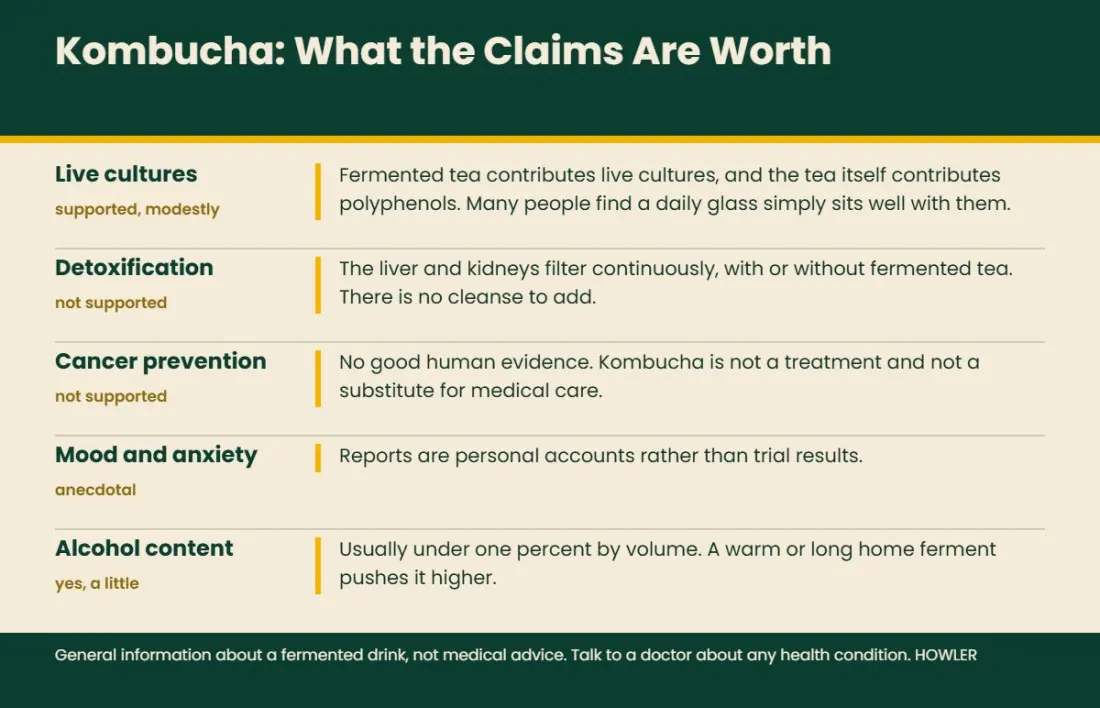
What's actually in the bottle is uncontroversial. Kombucha is tea and cane sugar fermented by a SCOBY — a symbiotic colony of bacteria and yeast. The result carries B vitamins, live cultures, tea polyphenols and organic acids that give it that sour bite. It also contains a small amount of alcohol, usually under 1% ABV, which can climb higher in warm conditions or with a long ferment. Worth remembering before handing a glass to a child or a non-drinker.
The claims are where things get shakier. Kombucha is credited with everything from better digestion and weight loss to detoxing, immune support and mood lifts. The evidence supports only the modest version: fermented foods contribute live cultures, tea contributes polyphenols, and many people simply enjoy a daily glass. There is no solid human evidence it prevents or treats any disease, and the popular "detox" idea doesn't hold up — your liver and kidneys filter continuously regardless of what you drink. Even probiotic research in general is mixed; the US National Center for Complementary and Integrative Health notes we often don't know which strains help or at what dose.
Some people should steer clear or ask a doctor first: anyone pregnant or breastfeeding (alcohol plus unpasteurized cultures), anyone immunocompromised or seriously ill, anyone avoiding alcohol entirely, and those with reflux or sensitive teeth, since the acidity is noticeable. Also read labels — some commercial brands add plenty of sugar or juice after fermenting.
For travellers, though, the fun angle is the market scene. If you want to try brewing your own, you need surprisingly little: a SCOBY, a large glass jar, some starter kombucha or vinegar, and a scrupulously clean setup. At the Tamarindo feria on Saturday mornings, vendors sell everything except the jar. The rules that matter: ferment only in glass (acid can leach from metal or glazed ceramic), and if fuzzy mold appears on the surface — distinct from the pale, rubbery new SCOBY that's supposed to form — dump the whole batch and start over.
Even if kombucha itself isn't your thing, the feria is. These markets are where you'll find the fresh produce behind the way Ticos actually eat, alongside artisanal foods and a very local Saturday-morning rhythm. Sampling a locally brewed kombucha while stocking up on mangoes and handmade tortillas is a far better souvenir than any wellness claim.
So drink it because you like it — that's reason enough. Just don't mistake a pleasant fermented tea for medicine, and see a doctor if something's genuinely wrong.