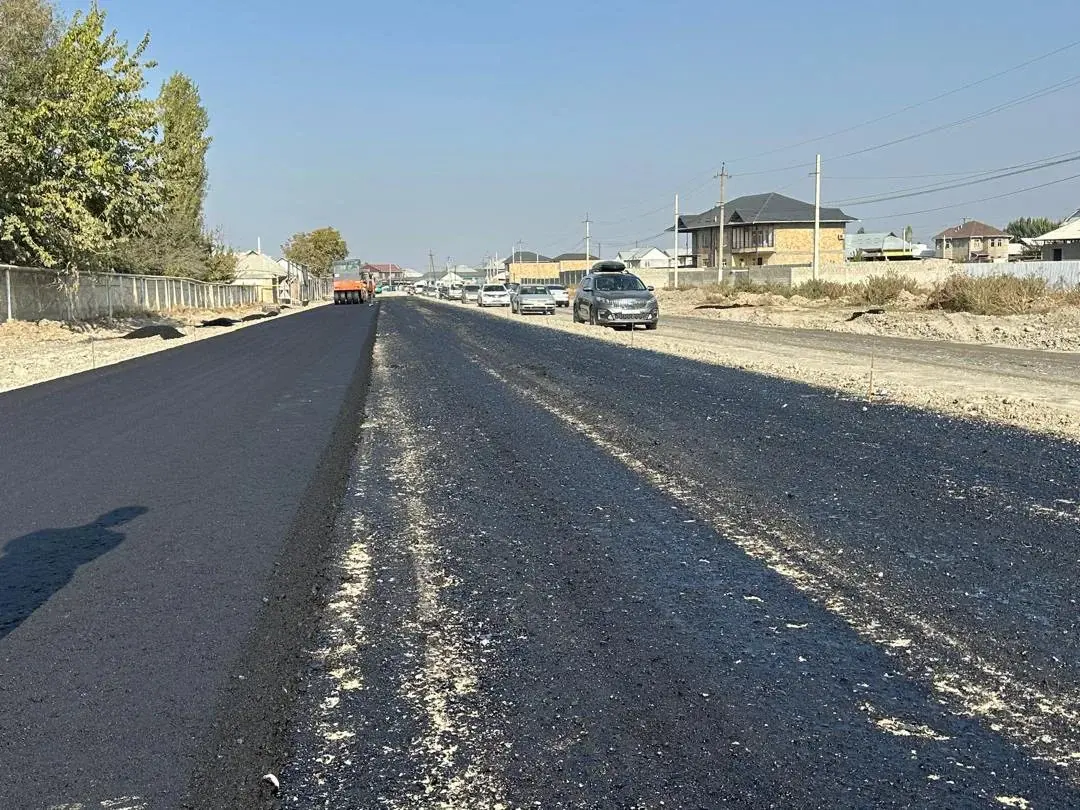
One of southern Kyrgyzstan's busiest stretches of road is getting a serious upgrade. Work is underway to rebuild the 18.69-kilometre route between Osh, the region's main city, and nearby Kara-Suu, turning what is now a congested corridor into a proper four-lane highway with a 22-metre-wide carriageway.
The Ministry of Transport and Communications says the road carries international traffic, including a steady flow of heavy goods vehicles, so the rebuild is designed with trucks in mind. The new pavement will be laid in two asphalt layers — 9 centimetres underneath and 6 centimetres on top, for a total thickness of 15 centimetres — which is a meaningful step up from a standard resurfacing job. Sidewalks and cycle lanes, each three metres wide, will run along both sides, a welcome feature in a part of the world where pedestrians and cyclists often share space with freight traffic.
It's a sizeable operation. Around 120 pieces of specialised machinery and 150 workers are on site, and the project includes four bridges, three of which are already finished. The stated goals are straightforward: better connections, more capacity and safer traffic.
For travellers, the significance is mostly practical. Osh is the usual jumping-off point for journeys into the Alay Valley, onward to Sary-Tash and the Pamir Highway into Tajikistan, or over to the Fergana Valley fringe. Kara-Suu sits close to the Uzbek border and hosts one of Central Asia's largest bazaars, so the corridor hums with cross-border traders, marshrutkas and lorries regardless of season. Anyone who has ridden or driven this stretch knows it can be slow, dusty and chaotic; a four-lane road should cut transfer times and make bus and shared-taxi journeys between Osh and the border area noticeably less bruising.
There's also a bigger picture. The route forms part of an international transport corridor through Central Asia, and Kyrgyzstan has been steadily upgrading its main arteries to handle growing regional trade. For visitors that usually translates into smoother overland travel — fewer potholes, fewer bottlenecks, and better infrastructure in towns along the way.
The works are ongoing, so expect some disruption — diversions, dust and the occasional wait at unfinished sections — until the project wraps up. But if you're planning a road trip through southern Kyrgyzstan in the next year or two, the drive through Osh region should end up easier and safer than it's ever been.