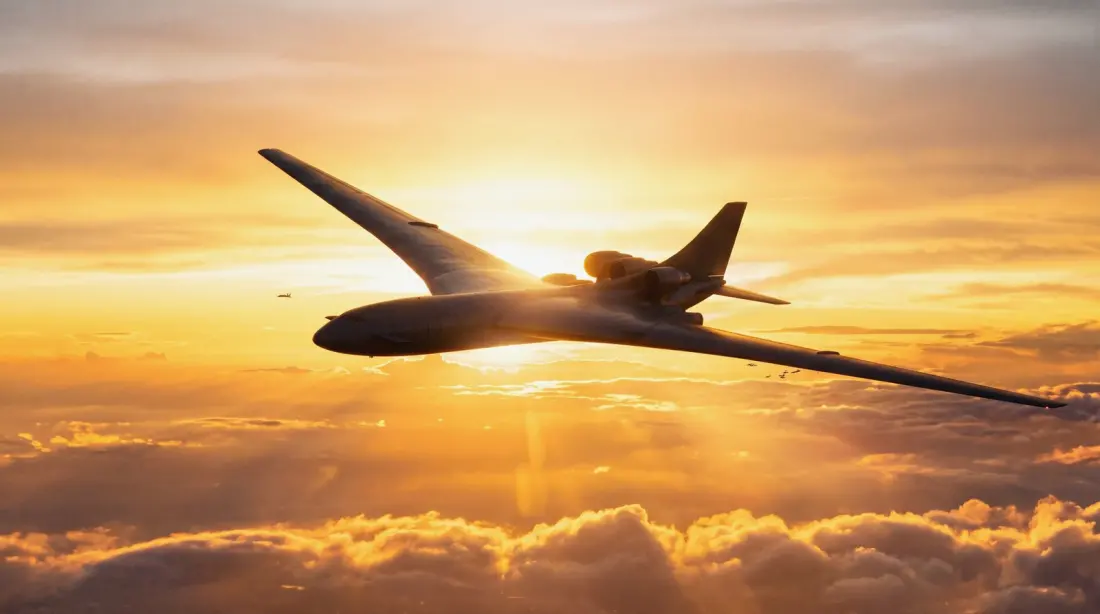
In September 1969, three Lockheed engineers filed a report describing the most outlandish aircraft ever put on paper: a nuclear-powered flying wing, wider than three football fields, designed to carry 22 fighter jets bolted beneath its wings. The CL-1201 never left the drawing board, but its story is a fascinating slice of Cold War aviation history — and a reminder of just how far the jet age's ambition stretched.
The numbers are staggering. The design weighed nearly 6,000 tons, roughly fifteen times a Boeing 747, with a wingspan of 1,120 feet. A liquid-metal-cooled reactor producing 1,830 megawatts would drive four giant turbofans at Mach 0.8, giving effectively unlimited range. The idea was to loiter over any conflict zone for 41 days at a stretch, eliminating dependence on overseas bases and allied airfields entirely.
Two variants were sketched out. The attack carrier version would carry a crew of 845 and deploy its fighters mid-air using a hydraulically stabilised trapeze hook lowered into the slipstream — a manoeuvre that would have required pilots to fly through violent vortex wash with wind spikes exceeding 37 metres per second. The logistics variant swapped fighters for cargo space, able to deliver an entire combat brigade of 3,896 soldiers and over 5,600 tons of equipment anywhere on Earth.
Then there was the takeoff problem. No runway on the planet could support its landing gear, so Lockheed proposed 182 dedicated lift jets for vertical takeoff — engines that would have produced a 1,400°F exhaust plume hot enough to melt asphalt, while burning the fuel equivalent of six fully loaded C-5 Galaxies in a single five-minute departure. Even beyond the engineering, the concept was strategically doomed: a 560-foot tailless airframe would be an enormous radar target for Soviet systems like the S-200, and one missile hit could crack open the central reactor.
The idea had roots in earlier experiments. In the 1930s, the US Navy's rigid airships USS Akron and USS Macon successfully launched and recovered Curtiss Sparrowhawk biplanes mid-flight — though both airships were later lost in storms, killing the program. The Air Force's own Aircraft Nuclear Propulsion program, which included the Convair NB-36H flying testbed with a live reactor aboard across 47 missions over Texas and New Mexico, was cancelled by President Kennedy in 1961 after 15 years and roughly $1 billion, largely because engineers never solved the shielding problem. Notably, despite popular claims, no records — including NASA memorandum X-2386 — show the CL-1201 was ever actually ordered.
Why does this matter to anyone who loves aviation? Because it puts modern air travel in perspective. The A380 once seemed like the ceiling of practical aircraft size; the CL-1201 shows what happens when strategic ambition outruns physics, infrastructure and common sense. For aviation enthusiasts, it's a genuinely great deep-dive topic — the kind of story that makes a visit to the National Museum of the US Air Force in Dayton, Ohio, or the USS Macon-related exhibits in California, feel like connecting with a stranger, wilder chapter of flight.
Story via Simple Flying.