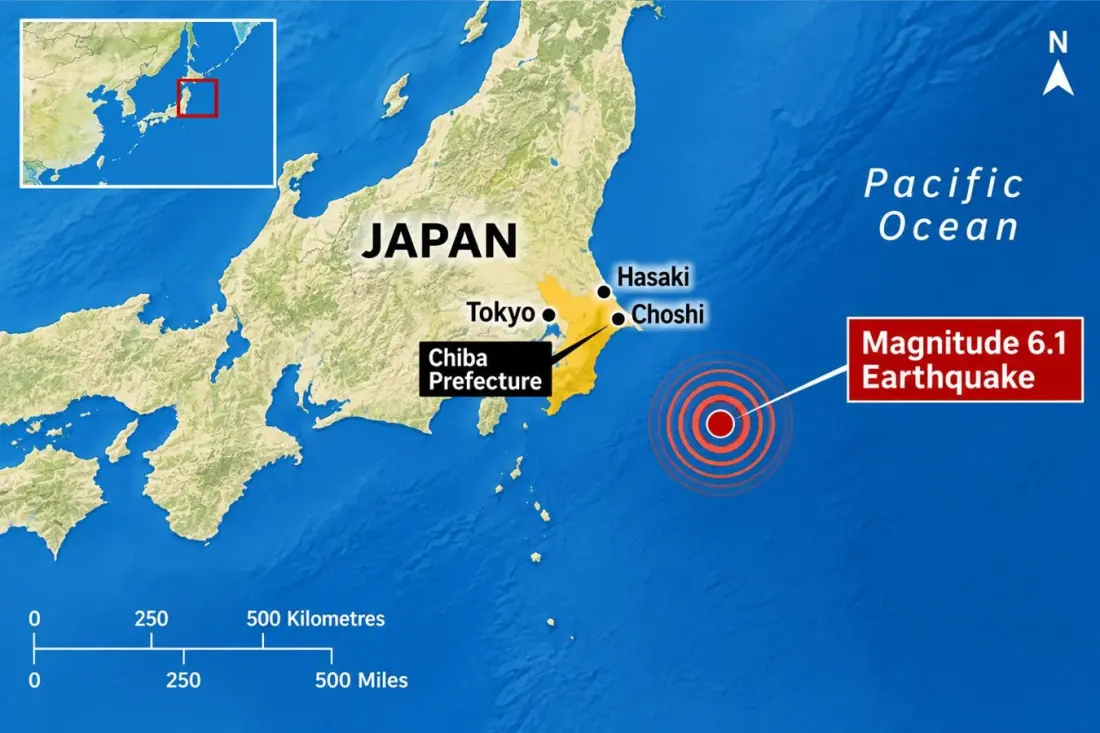
A magnitude-6.1 earthquake rattled the Pacific off Japan's eastern coast on the evening of Friday, November 6, but authorities quickly confirmed it posed no serious threat. The Japan Meteorological Agency (JMA) logged the tremor at 7:39 p.m. local time, with its epicentre offshore from the densely populated Kanto region at a shallow depth of 10 kilometres. The USGS put the epicentre about 156 kilometres southeast of Hasaki, near Choshi in Chiba Prefecture — the area directly east of Tokyo.
Shaking stayed mild on land. The JMA's maximum recorded seismic intensity was 3 on Japan's ten-level scale, felt across parts of Miyagi, Fukushima and Ibaraki prefectures in the northeast — places like Ishinomaki, Koriyama and Hitachi. At that level, most people indoors notice the movement and dishes can rattle, but there's no structural risk. The interesting wrinkle: the strongest shaking happened far from the epicentre, a reminder that Japan's intensity scale describes ground movement at specific locations, not the earthquake's overall size.
Fourteen minutes after the quake, the JMA issued a tsunami forecast for the Kujukuri and Sotobo coastal stretches of Chiba — but it was the lowest tier of alert, predicting sea-level changes below 20 centimetres over two to three hours. No tsunami warning or advisory followed, and no injuries or damage were reported.
For visitors, the takeaway is less about this event and more about how Japan handles them. Quakes of this size are routine here because the Pacific and Philippine Sea plates slide beneath the archipelago, making it one of the most seismically active countries on earth. The system works fast: the first intensity bulletin came out within two minutes, updated with epicentre and magnitude soon after, and tsunami messaging clearly distinguishes between harmless sea-level fluctuation and genuine danger. If you're travelling in Japan and feel shaking, check JMA alerts or the NHK World feed rather than social media — the graded system tells you quickly whether anything is actually required of you.
None of this should put anyone off a trip. Tokyo, Chiba's Pacific beaches and the Tohoku coast all operate normally through minor offshore quakes, and the country's building codes and alert infrastructure are among the best in the world.