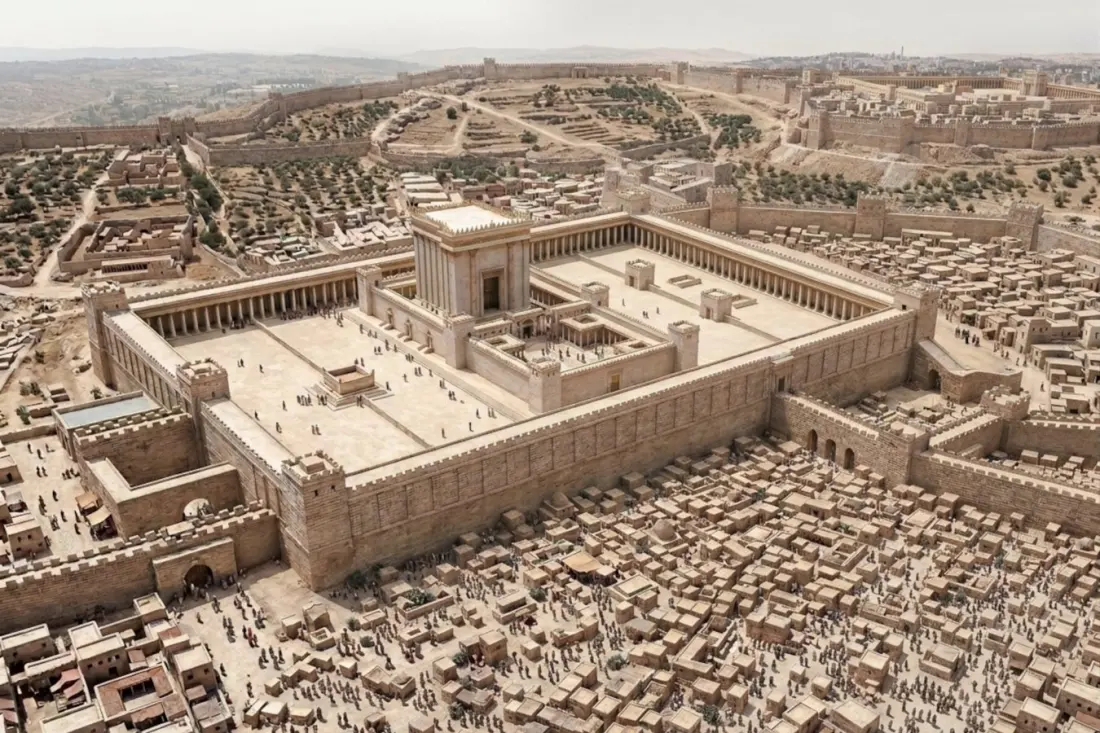
Archaeologists have uncovered a vast complex of ritual baths just south of Jerusalem's Temple Mount, in the Ophel area near the Triple Gate. The find, excavated by Hebrew University of Jerusalem's Institute of Archaeology, gives a rare physical picture of where Jewish pilgrims purified themselves before entering the Second Temple roughly two millennia ago.
The complex spans about 280 square metres and includes three large public ritual baths, a monumental plastered pool and a paved forecourt. The pool itself measures around 12 by 9.5 metres, with steps descending on all four sides. One bath still stands to 4.2 metres, complete with its vaulted stone ceiling and a water supply shaft. Drainage channels, in places over two metres tall, carried water toward the Kidron Valley — evidence the facility handled serious volumes of water, possibly fed by a branch of the aqueduct that supplied the Temple itself.
Prof. Uzi Leibner and Prof. Orit Peleg-Barkat, who led the dig, date the complex to the early first century CE, spanning the reigns of Augustus and Tiberius. Its size and position beside the Triple Gate, a main Temple entrance, point to public rather than private use: pilgrims arriving for festivals such as Passover, Shavuot and Sukkot would have needed somewhere to complete ritual purification before worship and sacrifice.
Beneath the monumental complex, researchers found something arguably more interesting — an earlier ashlar-built purification facility, probably from the first century BCE. That layered sequence suggests the area served pilgrims continuously across generations, not just as a one-off construction. The site's story ends dramatically: dozens of coins from the Jewish revolt were found on the floors and in the destruction debris, tying the complex to Jerusalem's fall in 70 CE during the First Jewish-Roman War.
For travellers, the discovery adds depth to any visit to Jerusalem's Old City. The chronology also places the baths squarely within the era of Jesus' life — the period when, according to tradition, his family presented him at the Temple. It doesn't mean he used these exact pools, but it does flesh out the bustling pilgrimage city of the era. Combined with earlier finds of ritual infrastructure along ancient pilgrim routes, Jerusalem is steadily revealing how it coped with festival crowds the size of a small city.
The Ophel dig sits just outside the walls near the southern Temple Mount excavations, an area visitors can already explore alongside the Davidson Center's Second Temple-era streets and gates. Anyone walking up to the Triple Gate today is tracing the same approach pilgrims used — pausing point included — on their way to worship.