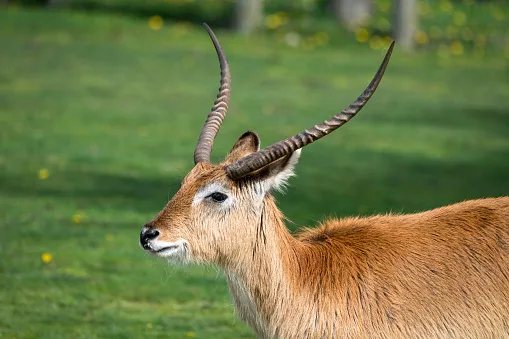
In the Kafue Flats of south-central Zambia, an antelope has made a home where most grazers would sink — literally. The Kafue lechwe spends its life wading through seasonally flooded grasslands, grazing in water up to its knees, thanks to elongated, widely splayed hooves that spread its weight across soft mud. It's one of the most specialised large herbivores in Africa, and one of the most vulnerable.
The Kafue Flats are a vast low-lying floodplain fed by the Kafue River, spanning shallow wetlands, reedbeds, permanent lagoons and open grassland. Each rainy season the river swells and drowns the plain; when waters retreat, fresh grazing emerges. That annual rhythm is everything to the lechwe — it dictates where grass grows, where the herds move and how they feed, especially in the dry season when seasonally flooded grasslands become their most reliable food source.
The trouble is that the rhythm has been broken. The Itezhi-Tezhi and Kafue Gorge dams, built for hydroelectric power, have rewired the natural flood cycle: some former floodplains are now permanently underwater while others barely flood at all. A 2024 scientific study found that more than half of the seasonally flooded grasslands have been lost. The consequences for the lechwe are stark — numbers have crashed from roughly 100,000 animals in the early 1970s to around 23,000 in 2022, with poaching and human pressure adding to the damage.
It's a classic specialist's dilemma. The very adaptations that let the lechwe exploit flooded terrain — those hooves, that taste for aquatic grasses — mean it can't simply relocate or switch diets when conditions shift. Its fate is tied to an entire ecosystem running on time.
Conservation efforts focus on restoring more natural seasonal water flows where possible, managing human pressures, and involving local communities who depend on the same floodplain for fishing and grazing. Parts of the flats fall within Lochinvar and Blue Lagoon national parks, but the ecological processes sustaining the lechwe stretch far beyond those boundaries.
For travellers, this is a compelling reason to put the Kafue Flats on a Zambia itinerary. Birdlife is superb, the wetland scenery is unusual by safari standards, and Lochinvar National Park in particular remains one of the few places to see lechwe herds en masse. Visiting supports the case that this landscape is worth protecting — and you'll witness one of Africa's most distinctive examples of wildlife shaped by water.