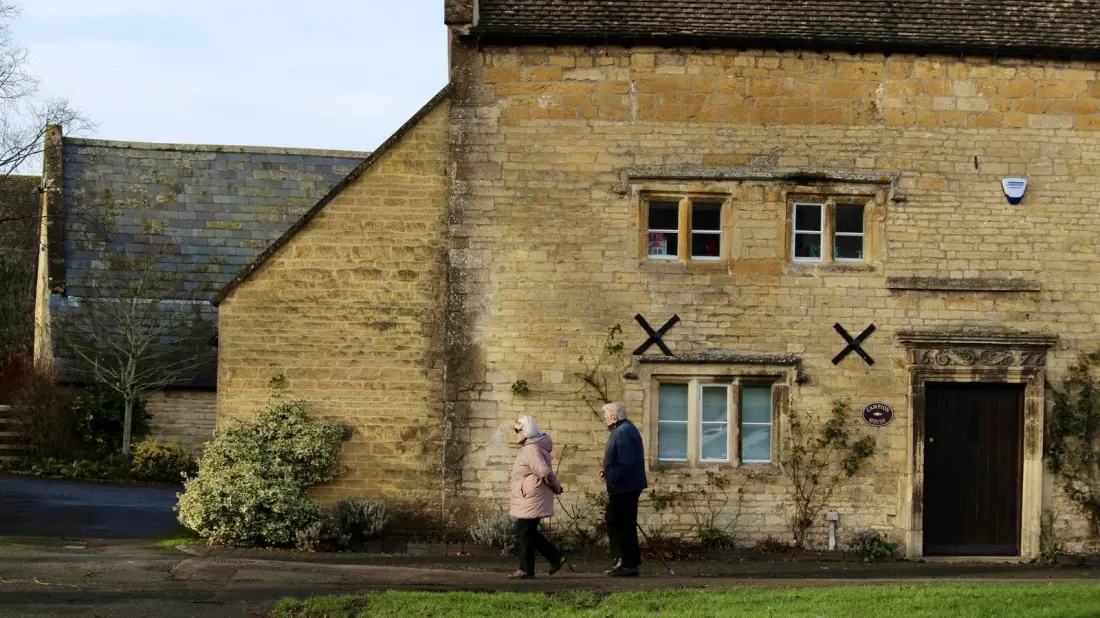
Most Cotswolds trips involve a rental car and a lot of narrow-lane stress. Moreton-in-Marsh is the exception. This honey-stone market town sits on the Fosse Way, a 2,000-year-old Roman road, and its unusually broad High Street doubles as the main attraction — lined with 17th- and 18th-century buildings, coaching inns, galleries and cafés. The width is no accident: a 13th-century abbot widened it deliberately when he turned the settlement into a market town, and that trade tradition is still going strong.
The Tuesday market is one of the biggest in the Cotswolds — roughly 150 stalls, swelling to 200 in summer — spilling down the High Street with produce, flowers, crafts and antiques. On non-market days you can still shop local: the Cotswold Cheese Company does Gloucestershire cheese tastings with artisanal ciders, and Otis & Belle bakery covers the pastry-and-tea stop. Look out for the Curfew Tower with its old clock and bell, Redesdale Hall (home to antiques and craft fairs), and the White Hart Royal, a coaching inn where Charles I apparently bedded down during the Civil War. There's also a small but touching Wellington Aviation Museum covering the town's WWII RAF aircrews.
What really sets Moreton apart is practicality. It has a railway station with direct trains from London Paddington and Oxford, plus buses to Broadway, Stow-on-the-Wold and Bibury — so you can base yourself here and see the northern Cotswolds without driving. Walkers get the Moreton Eight, a network of paths threading through farmland to nearby gardens and villages.
The surrounding sights are unusually good. Batsford Arboretum, just outside town, spreads across 60 acres with one of the UK's largest private tree collections — spectacular in spring when magnolias bloom, and again in autumn when the foliage turns burnt orange and gold. Sezincote House is the curveball: an early 19th-century Cotswold-stone mansion built in Indian style, complete with a green dome, minarets, ornamental elephants and a temple to the sun god Surya. Broadway Tower, overlooking Broadway village with its resident deer herd, and Bourton House Garden are both close by, and Chastleton House adds a stately-home option. Head eight miles down the Fosse Way and you hit Bourton-on-the-Water, the so-called Venice of the Cotswolds, linked to the twin villages of the Slaughters by a scenic circular walk.
For travellers who want the postcard Cotswolds without the parking headaches, Moreton-in-Marsh is arguably the smartest base in the region. It suits rail travellers, walkers, market browsers and anyone combining a countryside break with a day in Oxford — which is an easy train ride away. Come on a Tuesday for the market, plan around spring or autumn for the gardens, and give yourself at least two or three days to work through the villages at a civilised pace.