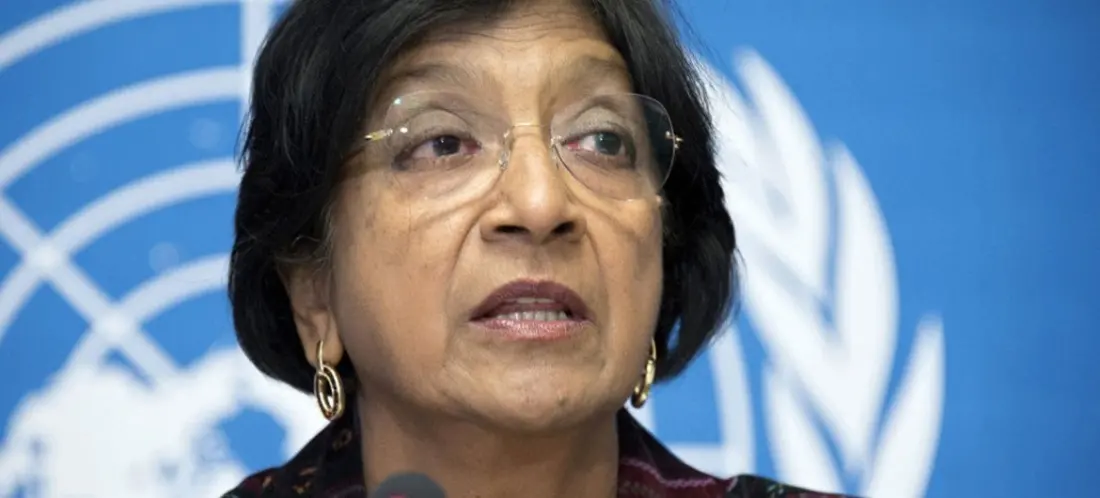
South African jurist Navi Pillay has been named the 2026 Nobel Peace Prize laureate, and the award lands at a pointed moment: international courts are facing sanctions, political pressure and open challenges from powerful states. Writing in Doha News, South Africa's Ambassador to Qatar Ghulam Hoosein Asmal frames the honour as less a personal tribute than a defence of the idea that no government stands above the law.
Pillay's own story explains why the committee's choice resonates. Born in Durban to a family of Indian descent, she came of age under apartheid and became one of the first non-white women to open a legal practice in Natal, defending anti-apartheid activists in a system designed to keep people like her out of courtrooms. She then went global: as a founding judge of the International Criminal Tribunal for Rwanda and its only female judge in its first four years, she helped secure the landmark 1998 ruling recognising rape as an act of genocide, later led the tribunal as its president, and went on to serve as UN High Commissioner for Human Rights. More recently she chaired the UN commission of inquiry on the Occupied Palestinian Territory.
The ambassador places Pillay in a distinctly South African tradition. Albert Luthuli won the prize in 1960 as apartheid intensified, giving the anti-apartheid struggle global legitimacy. Desmond Tutu followed in 1984 during the darkest years of repression, and Nelson Mandela and F.W. de Klerk shared the 1993 prize as the country negotiated its peaceful transition to democracy. Beyond peace, South Africans have taken Nobels in medicine (Max Theiler, Allan Cormack, Sydney Brenner), chemistry (Aaron Klug, Michael Levitt) and literature (Nadine Gordimer, J.M. Coetzee).
The op-ed's central argument is that Pillay's award arrives just as the institutions she served — the International Criminal Court, the International Court of Justice, tribunals and commissions of inquiry — are being openly undermined. Asmal's point, aimed partly at sceptics in the Global North, is that international law proved essential to ending apartheid itself, and that abandoning it whenever rulings prove inconvenient leaves only a world where might makes right.
Why should a traveller care? Because this is the moral history written into the places you walk. Durban, Pillay's hometown, carries one of the most layered stories in South Africa — Indian Ocean trade, indentured labour, apartheid-era segregation and the legal battles that dismantled it — visible everywhere from the city's Indian quarter to its courthouses and the Apartheid Museum trail that runs through Johannesburg. For visitors to South Africa, the laureate tradition is a genuine thread through museums, memorials and townships tours in Durban, Soweto and the Eastern Cape. Understanding the arc from Luthuli to Pillay turns a beach-and-safari trip into something with more depth, and it explains why this country punches so far above its weight in conversations about human rights.