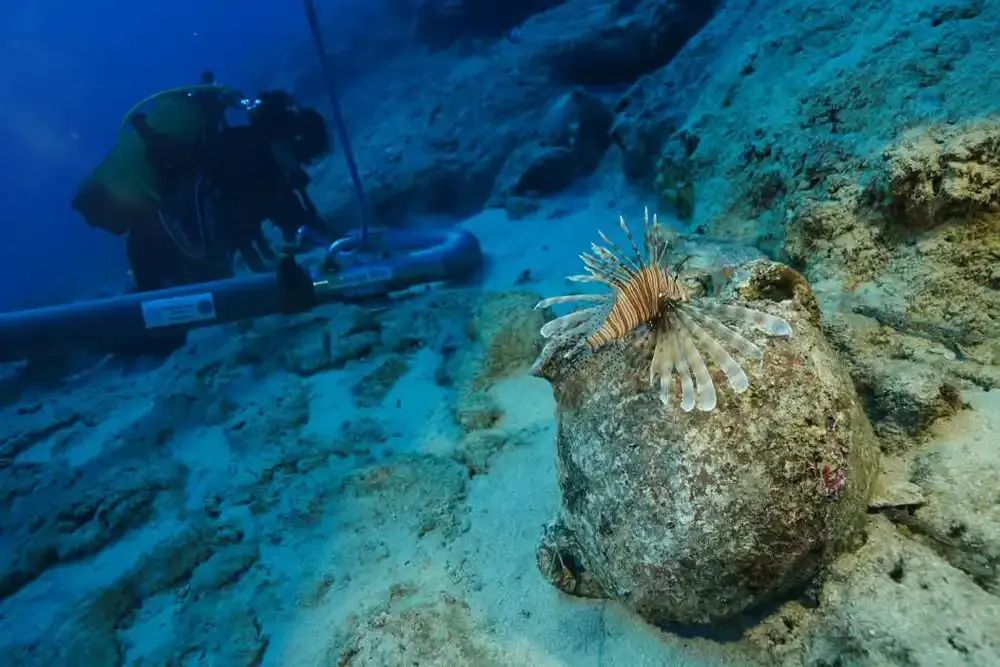
Divers working a rocky slope near Kekova Island, off Antalya on Turkey's Mediterranean coast, have recovered ceramic jars that may belong to the oldest shipwreck ever found. Turkey's Ministry of Culture and Tourism announced the discovery on 14 October, saying the amphorae date back as much as 4,700 years — to the Early Bronze Age, roughly when the Great Pyramid of Giza was under construction.
More than 30 large amphorae and three stone anchors lie scattered at around 30 metres, the remains of a merchant vessel thought to have been about ten metres long. No timber has survived, so archaeologists are dating the wreck purely from its cargo. The pottery style points to between 2700 and 2400 BC, and clay analysis suggests the jars were made in the Central Jordan Valley, in the southern Levant. Matching pottery has turned up at Giza, Saqqara and Abusir in Egypt, at Troy and on Crete — hints of a busy Bronze Age trade network linking the eastern Mediterranean.
The site was first documented in 2024 by a team from Akdeniz University led by underwater archaeologist Associate Professor Hakan Öniz, with formal excavations beginning in 2026 under the Antalya Museum Directorate. It hasn't been easy: the jars are embedded in rock covered in marine growth, and at 30m, divers get limited bottom time on each dive.
The finds are full of human detail. Several jars still hold visible residue after some 4,500 years underwater — likely olive oil, wine and tree resins. One oddball amphora, marked with nine distinct signs and pierced with two holes, may have been a churn for making cheese or butter, prompting speculation (unproven, the team stresses) that sailors carried live goats to produce dairy on long voyages. Researchers think the ship may have left a Levantine port and sailed west along southern Anatolia, perhaps bound for Troy or Minoan Crete. It probably sank after a storm drove it into the rocky coast.
If the dating holds, the Kekova wreck would eclipse the current record holder — a 4,200-year-old vessel found off Dokos in Greece. For divers and history lovers heading to Turkey's Lycian coast, it's another reason the waters around Kekova, already famous for its sunken Lycian city and underwater museum at Demre, rank among the Mediterranean's most compelling places to get wet. The recovered pottery will now undergo conservation and further testing to pin down its true age.