
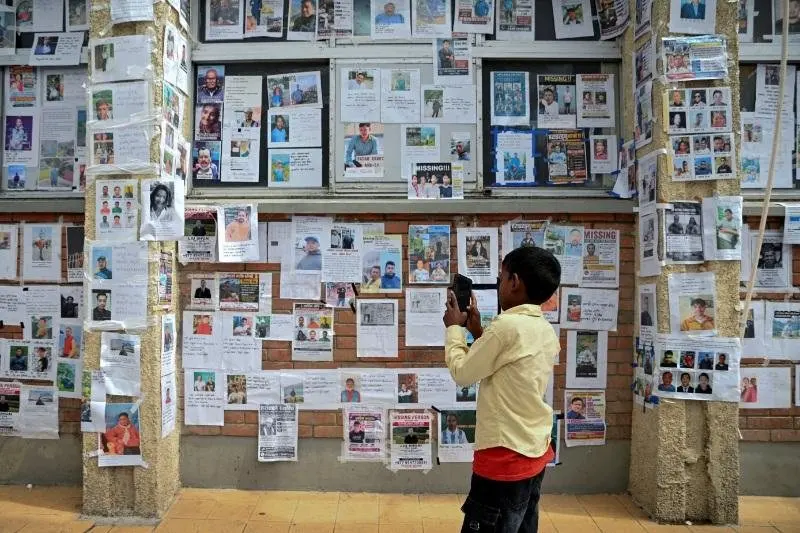
The numbers are hard to absorb: at least 1,386 people confirmed dead on the Nepali side, 5,130 still missing there, and on the Chinese side 43 dead and 519 unaccounted for — many of them foreign nationals. The cause was a glacial collapse high in the Himalayas that sent a torrent of mud, rock and water down onto the Gyirong Port crossing between Nepal and Tibet on 26 August, dumping an estimated 2.2 million tons of debris into the valleys and wrecking roads, settlements and hydropower infrastructure.
Among the missing are dozens of pilgrims. Arushi Gupta, a 33-year-old consultant from Hyderabad, texted her father from the border post that morning — '15 minutes walk to the border' — as she set off on the pilgrimage to Mount Kailash, the peak Hindus believe to be the home of Lord Shiva. Her WhatsApp trail stopped at the immigration post facade, the last photo she sent. Her family has since travelled to Kathmandu, toured hospitals, handed over DNA samples and even collected her suitcase from a hotel. They are still hoping.
They are not alone. Elena Horlova, a 42-year-old Ukrainian on a spiritual retreat with a group of 47 fellow Ukrainians, vanished near the same crossing. Her daughter, a film student in Bergen, Norway, has fired off around 30 emails to ministries and embassies across four countries and given a DNA swab to Norwegian police. One detail captures the agonising uncertainty: her phone's Find My app shows her mother's iPhone last active on the Chinese side of the border, while her Apple Watch and AirPods last appeared on the Nepali side.
The rescue picture is patchy. There have been genuine survivals — people pulled alive from tunnels in Nepal's hydropower plants — but the steady flow of official updates has slowed to a trickle. Nepal, China and India all say they are coordinating and that families will be informed promptly; China says it runs a hotline for relatives worldwide. Apple, which several families have contacted for location data, has not commented publicly.
Why should this matter to anyone planning a Himalayan trip? Because it puts a face on a risk that is growing, not shrinking. Glacial lake outburst floods are an increasing hazard across Nepal, Tibet and neighbouring mountain regions, and border crossings and river valleys sit squarely in the danger zone. Travellers heading for trekking routes, pilgrimage circuits or overland crossings in the region should check local alerts, know where higher ground is, keep documents and phones charged, and leave a full itinerary with someone at home. In a disaster like this, that last text message is often the only trace.
For now, the families keep waiting. Arushi's father is planning another trip to Nepal with his wife and son-in-law, convinced his daughter made it to higher ground on the Tibetan side. 'Miracles do happen,' he says. Search teams, relatives and embassies across at least four countries are hoping he is right.