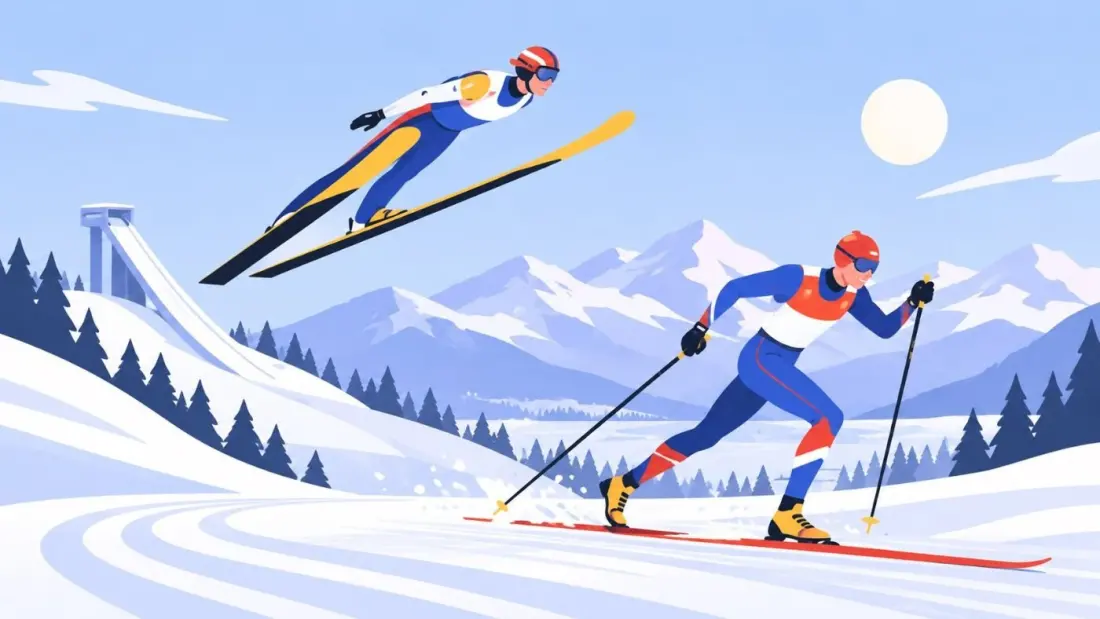
Ski flying, then a race. That's Nordic combined in a nutshell — and it's a sport invented, perfected and long dominated by Norway. As the Winter Olympics roll on, it's worth understanding the discipline that was there at the very first Games in Chamonix in 1924 and appeared at every edition since.
The idea is simple: athletes compete in ski jumping and cross-country skiing on the same day. Jumping rewards nerve, precision and technique; cross-country demands serious endurance. In the classic Individual Gundersen format, jumping results set the cross-country start order. Each jumping point converts to four seconds on the start line, so the best jumper goes first and everyone else chases. First across the finish line wins — no maths needed at the end, which makes it one of the easiest winter sports to watch as a spectator.
Norway is central to the story. The first major competition was held at the inaugural Holmenkollen Ski Festival in Oslo in 1892, designed to crown the best all-round skier. Ski jumping itself traces back to Norwegian officer Olaf Rye, whose 9.5-metre jump around 1808 is often called the first world record, and pioneer Sondre Norheim helped turn skiing from transport into sport. The Gundersen system is named after Norwegian athlete Gunder Gundersen.
The sport isn't standing still. A newer Individual Compact format, introduced to the World Cup in 2023-24, uses fixed time gaps (six seconds per place) instead of exact point conversions, keeping the field tight for more head-to-head racing. There's also a Mass Start, which flips the order — ski first, jump last — plus Team Sprint and Mixed Team events.
Two storylines matter right now. First, women's Nordic combined finally emerged internationally: the first women's World Cup race came in Ramsau, Austria in December 2020, won by American Tara Geraghty-Moats, and Norway's Gyda Westvold Hansen took the first world title at Oberstdorf in 2021. Yet women still weren't on the Olympic programme for Milano Cortina 2026, making it the only sport there without female competition. Second, and bigger: Nordic combined was left off the programme for the 2030 French Alps Games, ending its unbroken Olympic run that stretched from 1924 through 2026. The sport lives on through FIS World Cup events and World Championships, but its Olympic future is uncertain.
For travellers, this is a good excuse to think beyond Alpine skiing when planning a winter trip to Norway. Cross-country skiing is a national pastime — virtually every town has groomed trails — and watching a Nordic combined or ski jumping event, especially at Oslo's iconic Holmenkollen, is a memorable slice of local sporting culture. Even if you never strap on a jumping helmet, an afternoon on the cross-country tracks gives you a real appreciation for what these athletes do after they land.