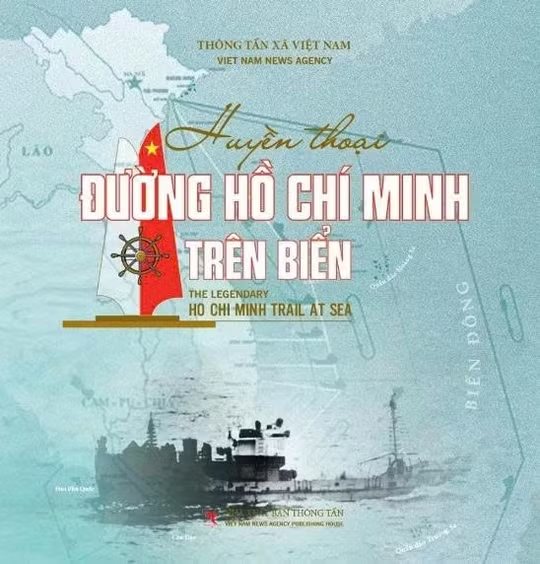
A piece of Vietnam's wartime maritime history has just been collected into print. The Vietnam News Agency Publishing House has released The Legendary Ho Chi Minh Trail at Sea, a 288-page bilingual Vietnamese-English photo book timed to the 65th anniversary of the route's opening on October 23.
The book gathers hundreds of photographs alongside archival documents, maps, artefacts and illustrations, arranged chronologically. Its subject is the covert sea corridor — known as the Ho Chi Minh Trail at Sea — used to ship weapons, equipment and medicine from the communist north to southern battlefields during the war against the US. The vessels that ran it were deliberately unnumbered, and crews faced storms, naval blockades and enemy fire on every passage. Many never came back.
Three chapters structure the story. The first covers 1946-1961, when secret voyages during the anti-French resistance quietly laid the groundwork for the later route. The second, spanning 1961-1975, is the heart of the book: the dangerous wartime crossings, the cat-and-mouse with blockades, and the support given by coastal communities and receiving forces on southern shores. It also honours veterans of Naval Units 759 and 125 and Vietnamese Heroic Mothers. The final section brings the story to the present, following the Vietnam People's Navy as it patrols and protects the country's seas and islands.
What makes the book more than a military archive is its focus on individuals. Through portraits and personal stories, it frames the route as ordinary people doing extraordinary, often fatal, work — a tribute as much as a history.
For travellers, this is useful background if you're exploring Vietnam's central and southern coast, where many of these landings and naval bases once operated. The route's legacy is visible in coastal towns, naval memorials and museums from the former DMZ region down to the Mekong Delta, and the bilingual format makes it a practical companion or souvenir for English-speaking visitors wanting to understand what happened along these waters between the 1940s and 1975. History-minded travellers heading to places like Ho Chi Minh City's War Remnants Museum or the wartime sites around Quang Tri will find it adds real depth.
— Vietnam News Life