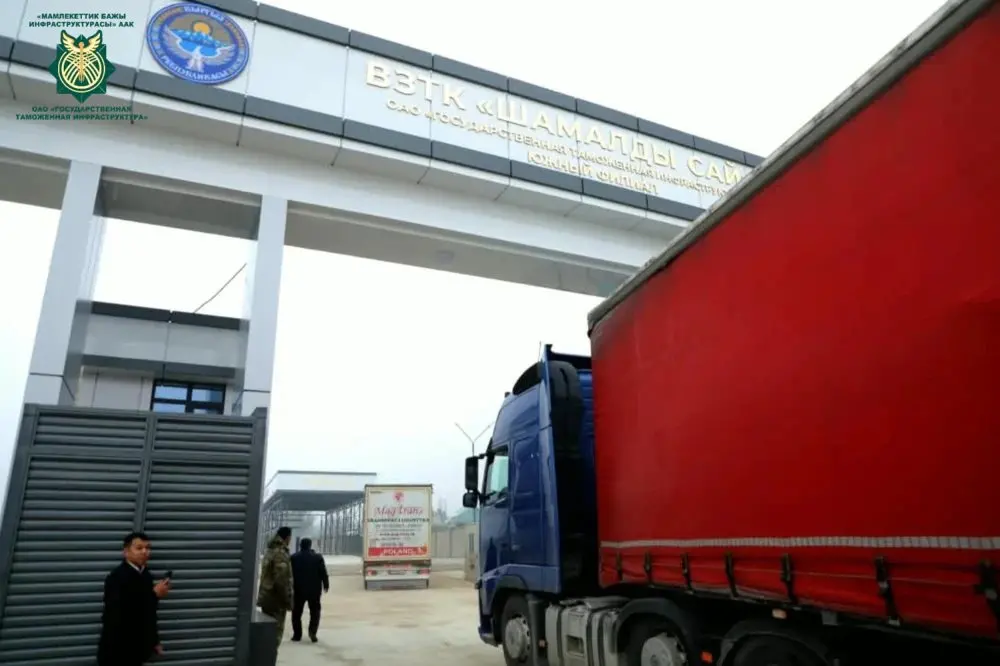
Overland travellers bouncing between Central Asia's highlights know the drill at the Kyrgyz-Uzbek border: long queues of lorries, paperwork shuffling and plenty of waiting around. That experience should improve following the opening of Ken-Sai, a new customs and logistics terminal in the village of Dostuk in Nooken district, Jalal-Abad region, on the Kyrgyz side of the border.
The facility is a serious piece of infrastructure. It sits on eight hectares and can hold up to 420 trucks at once — 220 bays for import operations and 200 for exports. Beyond truck parking, the terminal includes a weighbridge, a cargo transshipment area, customs inspection facilities and offices for customs brokers, so most of the paperwork and checks can now happen on-site rather than in a queue on the access road.
The standout feature for anyone crossing the border is the electronic queuing system. It is designed to organise truck traffic, cut congestion on the roads leading to the crossing and make life easier for freight carriers. For individual travellers, the knock-on effect is a border post that should feel less clogged by heavy vehicles and, in theory, faster to get through.
The project falls under the Southern Branch of State Customs Infrastructure OJSC, a Kyrgyz state push to upgrade border infrastructure in the country's south. Officials frame the terminal as a way to speed up international freight and deepen trade between Kyrgyzstan and Uzbekistan — two economies whose commercial ties have grown considerably in recent years.
Why should a holidaymaker care? The Dostuk crossing is one of the main land gateways between the two countries and sits on a logical route for anyone combining Kyrgyzstan's mountains with Uzbekistan's Silk Road cities. Coming from Jalal-Abad region, it connects naturally to the Fergana Valley side of Uzbekistan, with Namangan, Kokand and beyond within reach. If you have ever spent hours at a Central Asian border behind a wall of trucks, an orderly, computerised queueing system is genuinely good news — even if the direct benefit for passenger traffic will take time to show up.
The honest caveat: this terminal is aimed at freight, not tourists, so there is no promise of shorter lines for foot passengers just yet. But anything that reduces lorry congestion at a busy crossing tends to improve conditions for everyone using the road. If you are planning a Kyrgyzstan-Uzbekistan overland trip, it is worth tracking reports on crossing times at Dostuk before you lock in your route — and pairing the crossing with stops in Jalal-Abad and the Fergana Valley rather than treating it as a transit-only stretch.