Most travellers passing through Hanoi's Nội Bài International Airport see it as a gateway, not a destination. Local officials want to change that. The commune surrounding the airport — also called Nội Bài — sits on a mix of history, countryside and farm produce that could turn it into a short-stay tourism hub for the Vietnamese capital's northern edge.
That was the thinking behind an October 27 conference co-hosted by Hanoi's Department of Culture, Sports and Tourism and commune leaders, which gathered tour operators and experts to figure out how to convert raw potential into actual visitor products. The consensus: the ingredients are there, but the packaging isn't.
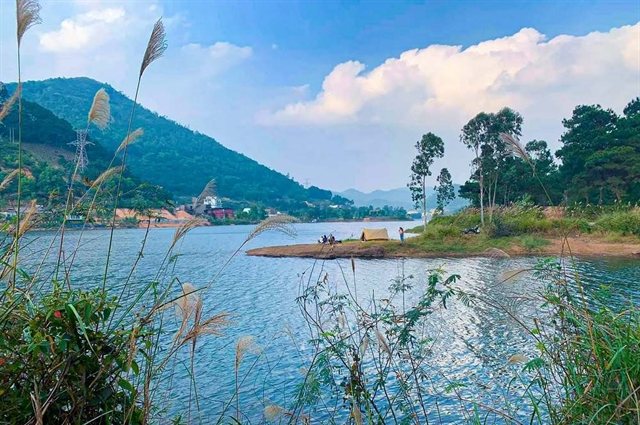
What's on offer? Thanh Nhàn Temple, a national-level heritage site dedicated to Saint Gióng, one of Vietnam's Four Immortals, is earmarked for spiritual and ritual tourism. Thành Chương Việt Palace works as a large private museum, using traditional architecture and folk artefacts to tell the country's cultural story — already a hit with local and foreign visitors. And Đồng Quan Lake, ringed by pine forest with mountains on the horizon, has quietly become a weekend escape for Hanoi's younger crowd.
Food and farm goods are another card to play. The commune counts 24 four-star and 10 three-star OCOP products (Vietnam's One Commune One Product scheme), which officials see as the backbone of an agritourism push tied to local production. Industry voices at the conference went further: the Việt Nam Travel Association's Phùng Quang Thắng pushed a green-tourism direction centred on Đồng Quan Lake as an eco-leisure space, while Hanoi Travel Association's Nguyễn Tiến Đạt suggested Nội Bài could become an OCOP shopping hub — even using space inside the airport terminal to showcase local goods to passengers with early arrivals or late departures.
The gaps are real, though. Commune Party Secretary Nguyễn Nam Hà was blunt that potential doesn't equal a product, and a product doesn't guarantee a market. Experts called for a digital tourism map, more hands-on experiences rather than photo-stop sightseeing, better infrastructure, restoration of historical sites, and stronger ties with travel companies to get Nội Bài onto established Hanoi itineraries.
For travellers, the takeaway is simple: if you're flying into Hanoi, the immediate surroundings offer more than an airport transfer. A morning at Thành Chương Việt Palace, an afternoon by Đồng Quan Lake and a bag of OCOP specialities can fill a long layover or justify an extra night outside the city centre. The area suits transit passengers, business travellers with a spare half-day, and anyone keen to see rural northern Vietnamese life without a long drive. Just expect things to keep evolving — the tourism push is still taking shape, so some services may be thin on the ground. Source: Vietnam News Life