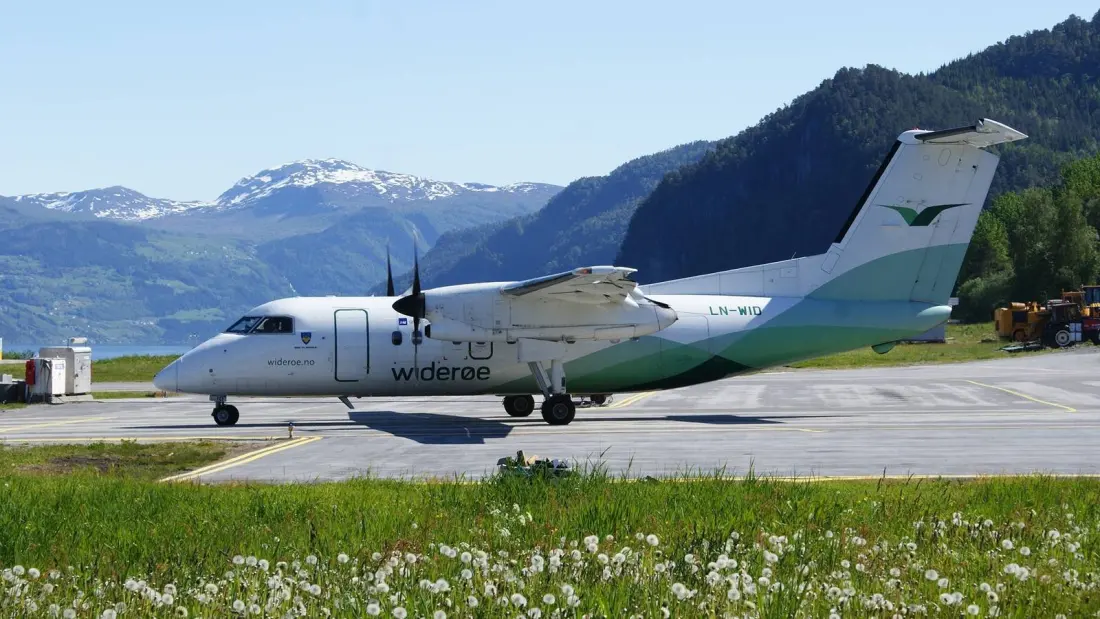
On 21 October, a Widerøe Bombardier Dash 8-100 registered LN-WIE pulled off one of the busiest day's work you'll see from any airliner: 17 flights between eight airports across Finnmark, Norway's northernmost county, in a single rotation spanning just over 17 hours. It left Tromsø at 04:12 UTC and wrapped up in Lakselv at 21:28, airborne for 8 hours and 34 minutes of that time.
The standout sector was Båtsfjord to Vadsø: seven minutes from takeoff to touchdown, shorter than the taxi time at many major airports. Another four flights ran under 20 minutes, and eleven of the seventeen lasted 35 minutes or fewer. The longest leg, Tromsø to Kirkenes, took just 1 hour 7 minutes — the only flight of the day to top an hour. The aircraft visited Hammerfest five times and Tromsø four, looping back through the same cluster of fields rather than flying a conventional point-to-point pattern. Its quickest turnaround was 18 minutes; the median across the day was about 23.
Here's the thing: none of this is meant to be commercially efficient, and that's exactly the point. These are public service obligation (PSO) routes, tendered and subsidised by the Norwegian Ministry of Transport because no airline would fly them otherwise. Widerøe won all 13 PSO routes in the 2017 tender round and remains the largest regional airline in Scandinavia, carrying around 2.8 million passengers a year. The 39-seat Dash 8-100 is the backbone of the operation — the only aircraft size that matches the thin demand on runways like Vardø, Båtsfjord and Alta.
That brutal cycle-heavy flying has consequences for the aircraft themselves. Every takeoff and landing counts as one flight cycle, and LN-WIE banked 17 before midnight. The Dash 8-100 was designed for 80,000 cycles; several Widerøe frames are past that already. In 2022 the airline became the launch customer for De Havilland Canada's ESP+ programme, which certifies the type to 160,000 cycles — the highest of any commercial aircraft — and Widerøe has since expanded its enrolment to 14 airframes. It's still the only customer, because nobody else in the world works these planes this hard. With no new 39-seat turboprop in production, extending the existing fleet is the only way to keep Finnmark's airports connected.
For travellers, this is one of Europe's most remarkable flying experiences: sub-20-minute hops over Arctic coastline, connecting villages no other airline touches, on a plane that's a flying piece of aviation history. If you're a region-counter or a turboprop enthusiast, a PSO-hopping itinerary through Finnmark is genuinely unlike anything else in mainstream aviation.