
A Chinese dive professional is being held in Sorong, Indonesia, after video surfaced allegedly showing him hunting a hawksbill turtle with a speargun near the Fam Islands in Raja Ampat — one of the most strictly protected marine areas in Southeast Asia.
Wei Shang, also reported as Wilson Shang, was detained on 14 September at Makassar airport while waiting for a flight to Kuala Lumpur. He is registered as an active AIDA freediving instructor trainer and an SSI Master Instructor, making the case especially awkward for both training agencies. Photos and video said to show the turtle being cooked and eaten circulated on social media before his arrest, and footage reportedly captures a speargun aimed at the animal's neck.
Shang denies killing the turtle. Police say the alleged incident took place between 8 and 11 September while he was diving with two other people, and investigators have also examined the homestay where he was staying. Evidence collected so far reportedly includes a cooking pot, five chopsticks and a black glove, along with video and photos allegedly showing the hunt and its aftermath. He remains detained in Sorong and has not yet been formally charged; if convicted under Indonesian conservation law, he could face up to 15 years in prison.
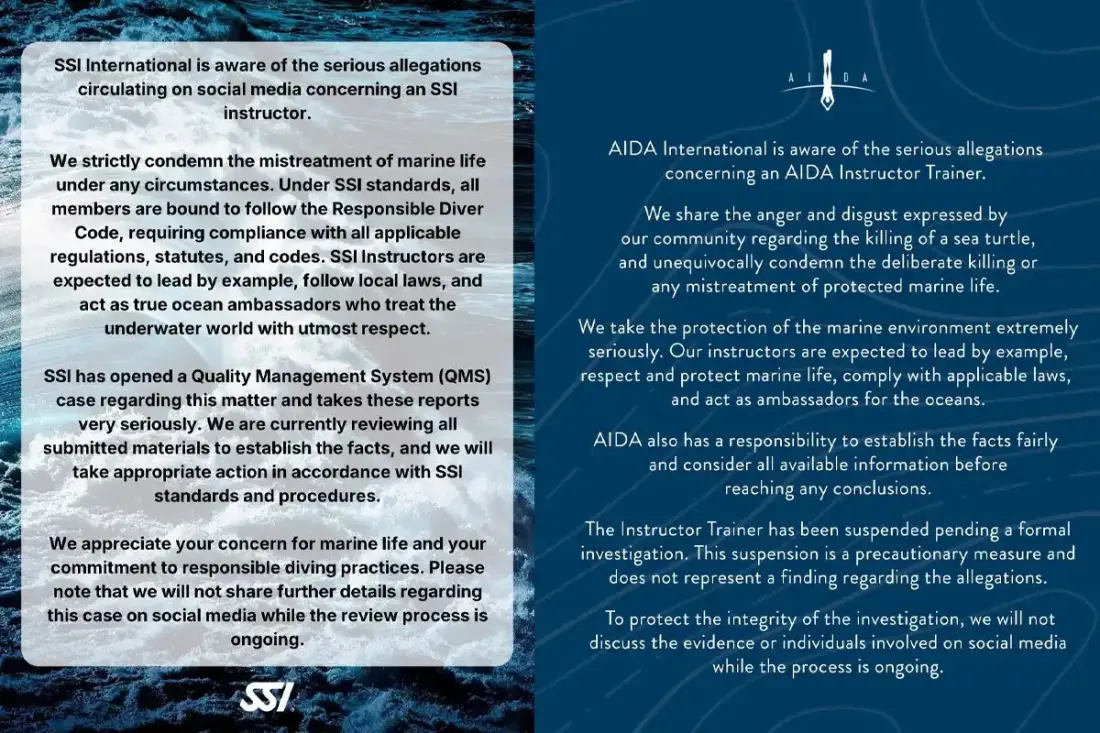
Both agencies have moved quickly. AIDA International has suspended Shang's instructor trainer status pending a formal investigation, saying it shares the anger of its community and condemns the deliberate killing of protected marine life without qualification — while stressing that suspension is precautionary, not a finding of guilt. SSI has opened its own inquiry through its Quality Management System, pointing out that members are bound by the Responsible Diver Code and expected to act as 'ocean ambassadors'.
Why it matters to travellers: Raja Ampat is the crown jewel of Indonesian diving, famous for the world's richest reef fish biodiversity, and hawksbill turtles are critically endangered. The case is a reminder that local conservation law applies to everyone — including qualified professionals — and that respected agencies will investigate members who cross the line. For visitors, it underlines the value of diving with reputable operators who enforce no-touch, no-take rules, and of knowing that spearguns are not permitted in the region's marine protected areas. Indonesia's dive industry, heavily dependent on its reputation for responsible tourism, has a clear interest in seeing this prosecuted properly.