If you're renting a car or driving your own through Colombia, a recent clarification from the Ministry of Transport is worth knowing before you hit the highway. The ministry confirmed that drivers cannot be fined for a first-aid kit that's missing individual items or contains expired medicines — but the kit itself still has to be in the vehicle.
The legal reasoning is simple. Colombia's National Traffic Code requires a first-aid kit but never defines an exhaustive list of its contents. The relevant traffic offence, called C.11, covers vehicles lacking the required roadside safety equipment. It does not let officers demand painkillers, specific bandages, sanitary products or unexpired medicines. So if a roadside inspector writes you up purely because your kit is missing gauze or a painkiller has passed its date, that citation can be challenged through the administrative traffic procedure — and the ministry's interpretation gives you solid ground to argue it.
That said, the required equipment list is real and worth double-checking before a long drive. Under Article 30 of Law 769 of 2002, vehicles on Colombian roads must carry: a jack that can lift the vehicle, a lug wrench, two reflective warning triangles (or flashing yellow warning lamps), a first-aid kit, a fire extinguisher, two wheel chocks, a basic tool kit (pliers, screwdrivers, an adjustable wrench and fixed wrenches), a spare tyre and a flashlight. Missing any of these can trigger a C.11 citation carrying a fine of 15 daily legal minimum wages — not pocket change.
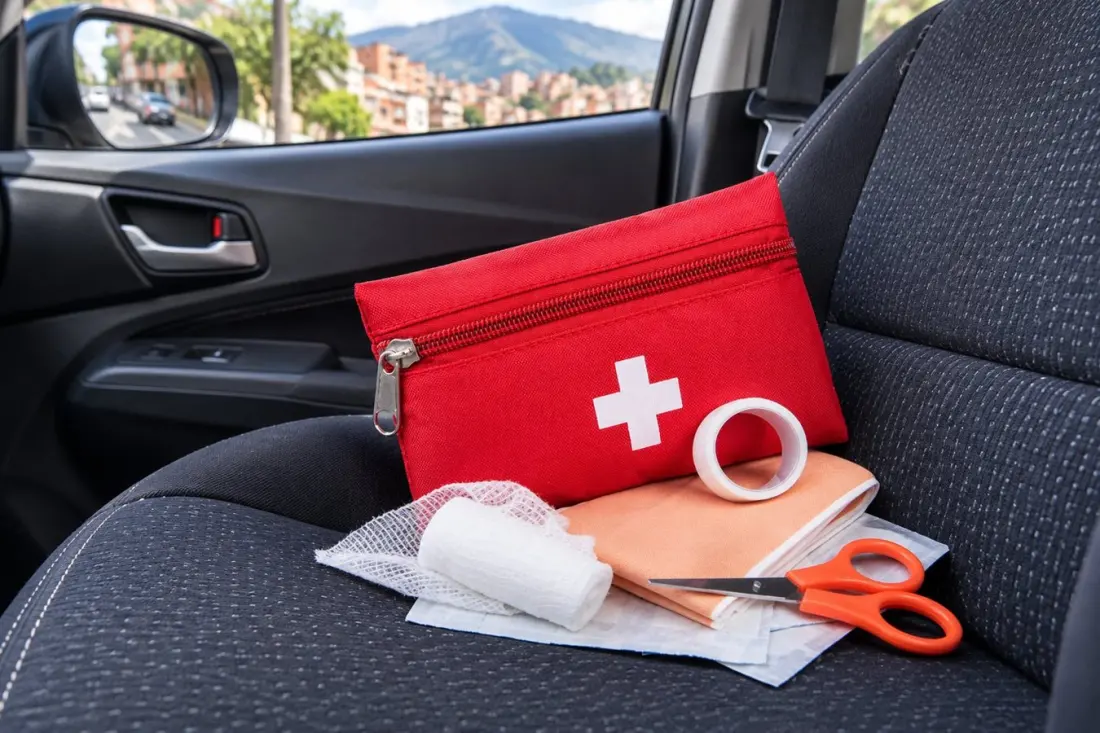
As for what belongs in the kit itself, that's up to you, but Colombian pharmacies, automotive stores and retailers sell ready-made options. A practical setup covers antiseptics (alcohol, hydrogen peroxide, saline solution, povidone-iodine), wound dressings (sterile gauze, elastic and adhesive bandages, medical tape), cotton wool, tongue depressors, disposable gloves and scissors for cutting dressings. Medicines aren't legally required, so anything you add voluntarily should be checked and replaced regularly — sensible rather than obligatory.
For travellers, this matters most on longer routes where police checkpoints are common, such as the highway between Bogotá and Medellín or drives through coffee-country roads. Knowing the exact legal requirements helps you push back politely if an inspection goes beyond the rules, and it's a reminder to confirm your rental actually has the full safety kit before leaving the lot. A well-stocked kit is still smart on remote stretches where medical help may be far away — just not something you can be fined over.
Story first reported by Colombia One.