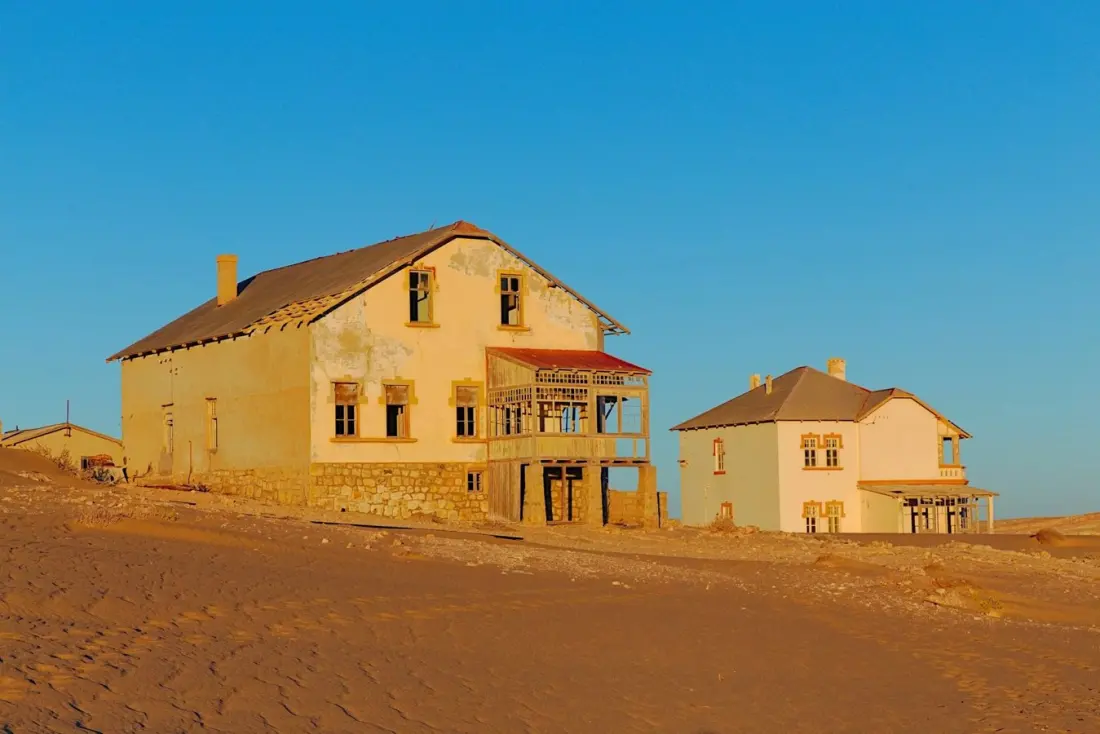
Southern Africa has its fair share of places that boom, bust and went quiet — and several of them are surprisingly easy to visit. From a diamond town being swallowed by dunes to a gold rush settlement now a living museum, here are five worth putting on a road trip itinerary.
Kolmanskop, Namibia, is the poster child. Diamonds were found near Lüderitz in 1908, and German miners built a proper town in the desert — hospital, school, ballroom, casino, even a tram. When richer deposits turned up further south, the residents left, and by 1956 the place was empty. Today sand pours through windows and fills rooms nearly to the ceiling, a look you may recognise from the cover of Tame Impala's 2020 album The Slow Rush. Access is via guided tour.
In South Africa's Knysna Forest, the Millwood Goldfields tell a different story. An 1880s gold rush spawned a settlement almost overnight; when the gold fizzled, the forest quietly reclaimed it. Moss-covered ruins and rusting mining equipment now sit among the trees in the Goudveld section, a conservation area where access is regulated.
Leydsdorp in Limpopo boomed in the late 1880s with thousands of residents, a hospital, bakery, printing house and magistrate's office. Malaria and richer gold finds elsewhere drained the town away. Only fragments remain — a reminder that ghost towns are often killed by economics, not disaster.
Not every ruin is a town. On Mozambique's Pinda Peninsula, a lighthouse built by the Portuguese in 1923 to guide ships through Memba Bay now stands abandoned above the coast. It has historically been open to visitors, and the remote, windswept journey there is half the appeal.
Finally, Pilgrim's Rest in Mpumalanga barely qualifies as abandoned — gold was discovered there in 1873 and the town is now a preserved heritage site and living museum. But it leans into its spooky side: the former mine manager's home, Alanglade House, features on local ghost tours, and the historic cemetery has its own share of tales.
A quick reality check before you go: abandoned doesn't mean unowned or safe. Some sites sit on protected or private land, and structures can be unstable. Stick to designated areas, use a guide where required, and leave the souvenirs where they lie. Done right, these places offer something rare — a walk through histories of gold, diamonds and ambition that didn't quite last.