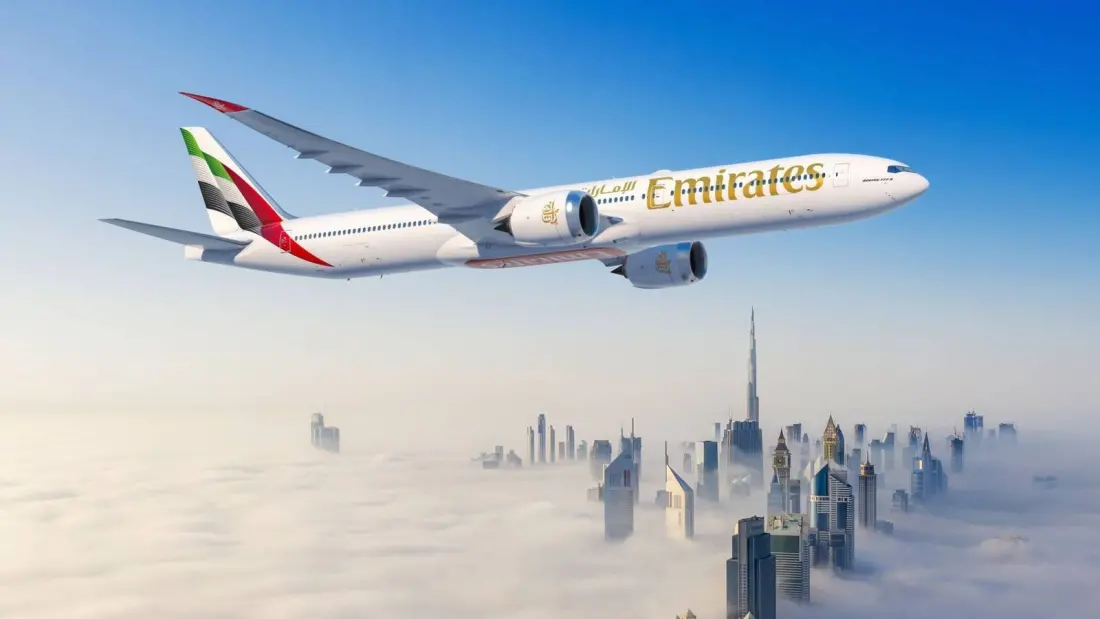
Emirates flies one of the largest all-widebody fleets on the planet — over 250 aircraft from just three types: the Airbus A380, the Boeing 777, and, more recently, the A350-900. Yet when you look at its orderbook, one plane dwarfs everything else: 270 Boeing 777Xs, compared to 73 A350-900s (30 already flying, 43 still to come) and 35 Dreamliners. That's an unusual split in an industry where most long-haul carriers are piling into the smaller A350-900 and 787-9.
The reason comes down to how Emirates does business. The airline's whole model is built on funnelling huge passenger volumes through its Dubai hub, which keeps unit costs low and fares competitive. With Dubai International close to capacity, the only realistic way to grow is to fly bigger planes, not more of them. The 777-9 — the largest airliner still in production, with 235 of Emirates' 270 orders — carries more seats than the 777-300ER it replaces, making it a natural fit. Adding more A350s, by contrast, would mean either keeping capacity flat or actually shrinking it per flight.
There's history here too. Emirates first ordered A350s back in 2007, cancelled in 2014, and only re-ordered in 2019 as part of the deal that ended the A380 programme — essentially an opportunistic buy. The 777X order, placed in 2013, has always been central to the long-term plan.
The 777X also suits Gulf conditions. It was designed with input from Emirates, Etihad and Qatar Airways, whose hot, dry hub airports degrade engine performance. The General Electric GE9X engines set a thrust record above 134,000 lbs in testing but are rated to just 110,000 lbs in service — meaning they run with plenty of margin, which helps reliability. Emirates has been more sceptical about the durability of the Rolls-Royce engines on the A350-1000.
What does this mean for travellers? Emirates expects the 777X to replace not only its 117-strong 777-300ER fleet but also part of its A380 fleet, which will gradually shrink ahead of full retirement in the 2040s. In a few years, the plane most associated with Emirates probably won't be the superjumbo — it'll be the 777X. Expect the airline's signature high-volume, hub-and-spoke experience to continue, just on a slightly smaller but far more fuel-efficient aircraft. The A350s, meanwhile, will open up thinner routes that the giant planes could never serve profitably — good news if you're flying Emirates to a secondary destination.
One footnote for aviation watchers: the current orderbook also includes 20 787-8s and 15 787-10s — but not a single 787-9, the variant nearly every other airline buys. Emirates rarely does things the conventional way.