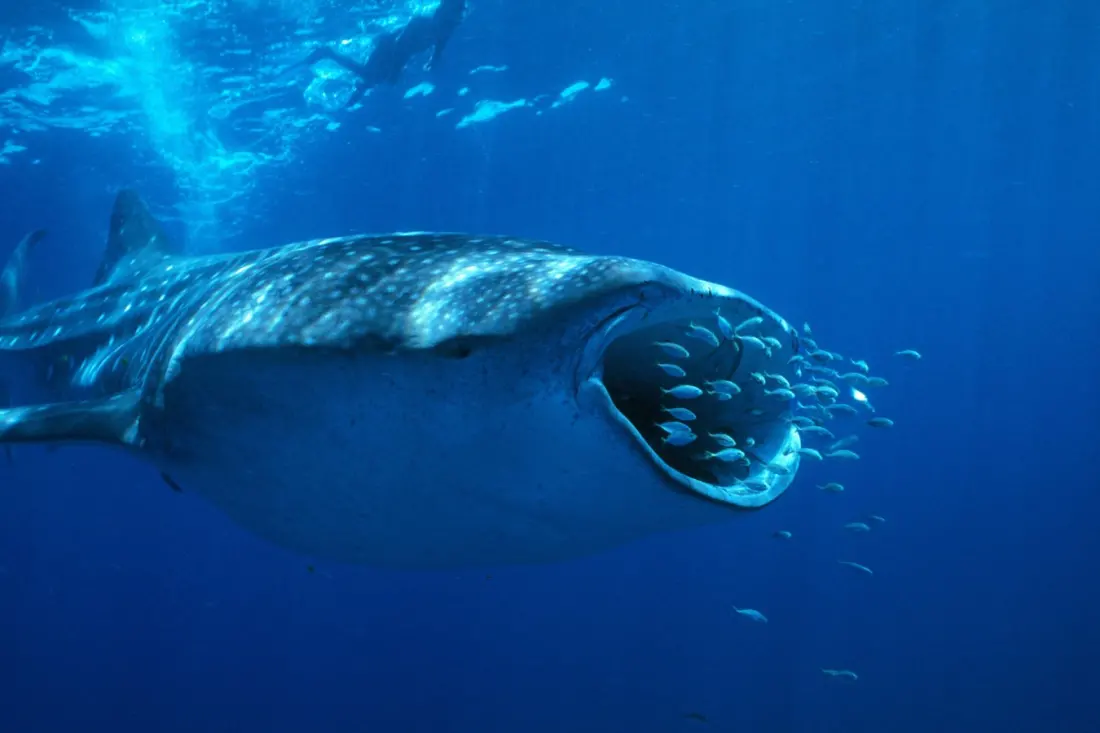
Ningaloo Reef, already famous as one of the few places on Earth where you can swim with whale sharks, has just added another claim to fame. Researchers from the Australian Institute of Marine Science and Murdoch University stuck cameras onto the world's biggest fish as they gathered off Western Australia's coast — and caught them eating in ways that had never been documented before.
Two newly observed techniques stood out. The first, dubbed "gliding slow feeding", sees a shark sink through the water with its mouth wide open, passively scooping up whatever drifts in. The second, "dive feeding", is more dramatic: the shark heads straight for the seafloor, hoovering up prey along the entire descent. For an animal that can grow longer than a bus, that's a surprisingly flexible set of dining habits.
The reason for all this creativity comes down to maths. Whale sharks feed mostly on plankton and tiny creatures like copepods — extremely small prey for an extremely large animal. Lead author Christine Barry, a PhD candidate at AIMS and Murdoch University, put it plainly: the ocean's biggest fish being so food-obsessed makes sense when its meals are among the smallest. What surprised the team was simply how many different ways the sharks had invented to get enough of it.
The study, published in the journal Marine Biology, also underlines why Ningaloo matters. Every year, between roughly March and August, whale sharks congregate along this stretch of the World Heritage-listed reef following the coral spawn, making it one of the most reliable aggregation sites on the planet. One researcher described the area as a kind of safe pantry for these giants — a place where they can refuel without stress. That makes the reef not just a scientific treasure but a conservation priority, since protecting the pantry is what keeps the sharks coming back.
For travellers, the takeaway is simple: Ningaloo remains the gold standard for whale shark encounters. Unlike cage dives or baited setups, swims here happen on the sharks' terms, in open water, with licensed operators from Exmouth or Coral Bay leading small groups. The sharks are filter feeders and pose no threat to swimmers, and the encounters — a few minutes at a time alongside a calm, spotted giant — are regularly described as a lifetime highlight. And if you're snorkelling over the reef's inner lagoon while you wait for your turn, you'll be floating above one of the healthiest coral systems in the world.
If swimming with whale sharks is on your list, this new research is a good reminder of why places like Ningaloo need thoughtful tourism. Choosing a licensed, eco-accredited operator means your visit supports the same waters these animals depend on for their constant snacking — now documented in more detail than ever.